


Heavy-Duty Crane Procurement Schedule Optimization for Steel Plants
Jun
The procurement and installation schedule for ultra-heavy lifting equipment can become a critical bottleneck in steel plant projects. Delays in engineering design, technical drawing approval, or the supply of imported European heavy-duty crane systems can push project costs beyond budget and damage the contractor’s commercial reputation.
How can EPC contractors balance strict metallurgical safety requirements with the need to shorten equipment delivery schedules? This article from VINALIFT analyzes engineering and supply chain strategies that help optimize heavy-duty crane procurement schedules while maintaining high system reliability.
Critical path challenges
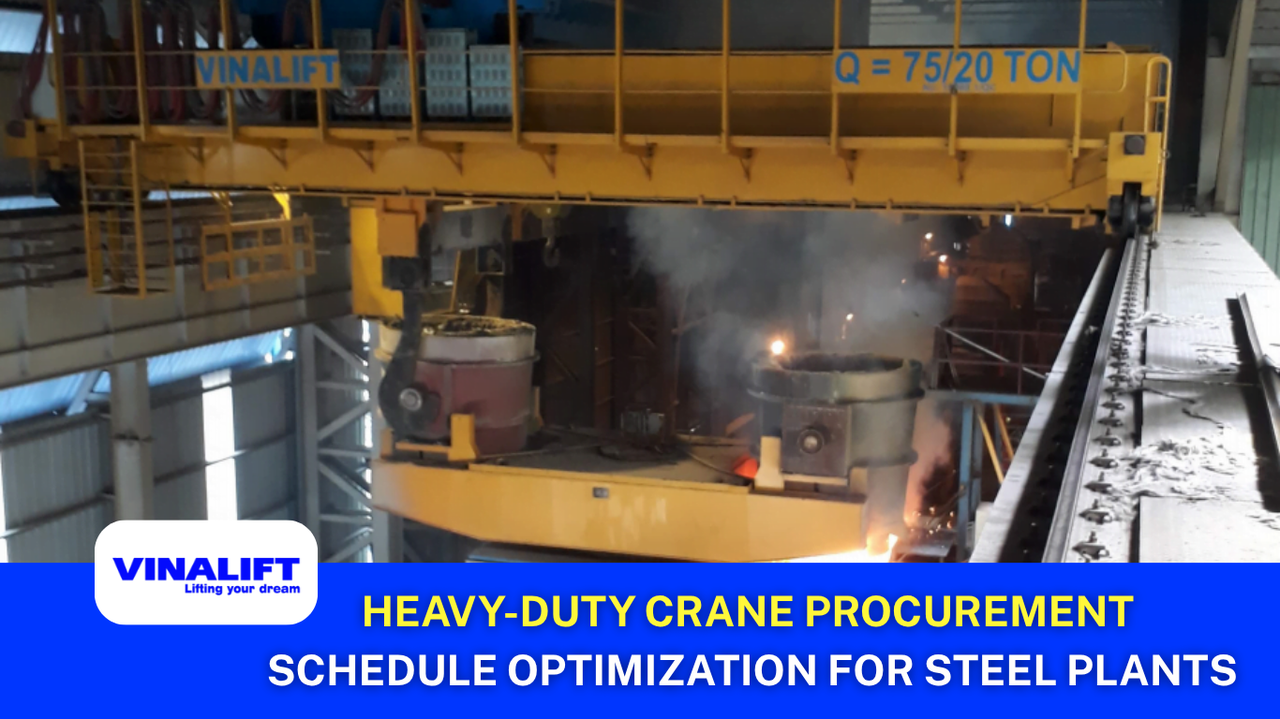
In EPC management for steel plant projects, cranes specified for Utilization Class U8/U9 and Load Spectrum Class Q4—particularly charging crane systems and ladle crane systems—always represent the critical path that determines the overall project schedule. Any delay at this stage creates a domino effect, postponing load testing, electric arc furnace (EAF) installation, and ultimately increasing project costs and creating schedule pressure for the EPC contractor.
In many heavy-industrial EPC projects, schedule delays typically originate from three primary sources:
- Design approval disagreements: Clarification of complex dynamic performance parameters between the EPC contractor and the manufacturer may take several months.
- Excessive lead time for critical components: Specialized components—including impact-resistant gearboxes, Class H insulated motors, and emergency braking assemblies—imported from Europe often require lead times of six to eight months.
- Complex FAT procedures: Fatigue resistance verification, weld ultrasonic inspection, and dynamic performance testing require stringent standards and substantial testing time.
To resolve the conflict between strict metallurgical safety requirements and accelerated delivery schedules, VINALIFT implements a synchronized optimization strategy covering both engineering design and the entire supply chain.
Standardized Engineering Design Based on International Standards and FEA Verification
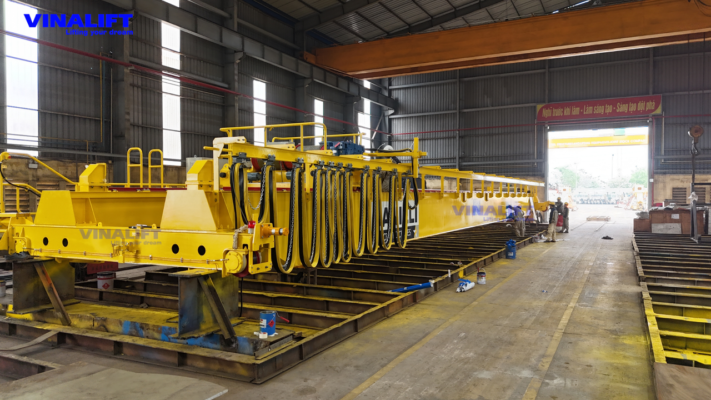
One of the most common mistakes during the Invitation to Bid (ITB) preparation stage, which significantly extends the clarification process, is specifying an incorrect Duty Class. For the demanding operating environment of steel plants, VINALIFT standardizes engineering design according to the industry’s most stringent international standards.
Crane duty classification is defined according to FEM 1.001 and EN 13001, while structural design and load calculations are verified to meet the safety requirements of heavy-duty metallurgical crane applications.
- Class of Utilization (U): Classified as Utilization Class U8/U9, with a total design life exceeding 2 x 10^6 operating cycles, meeting the continuous 24/7 operating requirements of steel plants.
- Load Spectrum (Q): Classified as Q4 (Very Heavy), as ladle crane applications handling molten steel continuously operate near the maximum rated load.
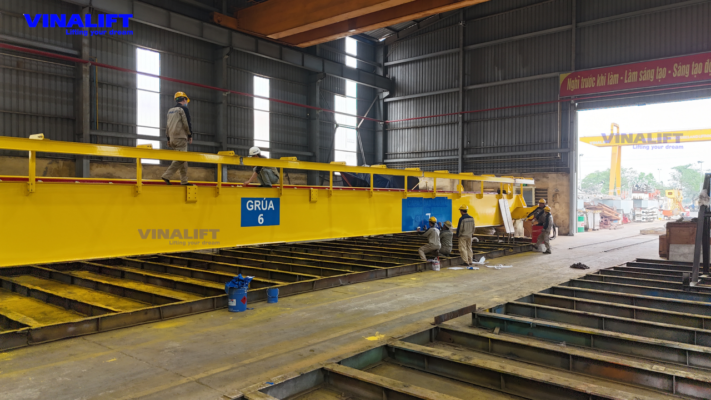
To reduce the technical drawing approval period to only 2-3 weeks, VINALIFT applies Finite Element Analysis (FEA). Using FEA, VINALIFT engineers verify stress distribution, deflection, fatigue life, deadweight, and dynamic impact effects, allowing the box girder plate thickness to be optimized before manufacturing.
Implementing the Single-Failure-Proof Design Philosophy
The girder structure of VINALIFT’s ladle crane is engineered to withstand radiant heat from molten steel at temperatures of up to 1,600°C while maintaining the temperature of the primary load-bearing structure below 70°C through a multi-layer heat shield system filled with ceramic insulation.
To prevent an uncontrolled ladle drop, one of the most catastrophic failure scenarios in metallurgical production, the hoisting system should incorporate a single-failure-proof design with a redundant load path.
- Dual-Rope Reeving System: Two independent wire ropes are reeved through an equalizer bar equipped with wire rope break detection sensors. If one rope fails, the remaining rope is designed to support 100% of the rated load.
- Two-Tier Braking System: The system integrates a service brake mounted on the high-speed shaft and an emergency hydraulic caliper brake acting directly on the rope drum flange. This redundant braking architecture is designed to prevent uncontrolled load descent by directly locking the rope drum if the gearbox output shaft fails.
VINALIFT has successfully delivered:
- Steel Industry – 80/20T Double Girder Overhead Crane | Specialized Lifting Solution for Steel Plants: VINALIFT supplied an 80/20-ton double girder overhead crane system for the Hoa Phat Dung Quat Integrated Iron and Steel Complex.
- Steel Industry – 10T Gantry Crane | Thai Nguyen Iron and Steel Joint Stock Corporation (TISCO): Designed for billet handling operations within the steel plant.
Smart Solutions: Smart Crane and Predictive CMS Monitoring
To minimize unplanned downtime, VINALIFT digitizes crane operations through an intelligent automation platform.
- Sensorless Anti-Sway System: A mathematical control algorithm is embedded directly into the VFD, automatically adjusting acceleration according to the actual rope length to suppress load swing without relying on external sway sensors exposed to dust or smoke inside the workshop.
- Absolute Positioning System: Determines the crane operating position with an accuracy of within ±5 mm, enabling the creation of No-Fly Zones to protect substations and control rooms.
- Magnet Controller with Dribbling Function: This feature helps resolve the common issue of magnetic lifting systems picking up multiple steel plates due to residual magnetic force. Operated through the joystick, the dribbling function precisely regulates magnetic current to release excess plates while retaining a single plate within two seconds, helping protect the finished product surface from scratches.
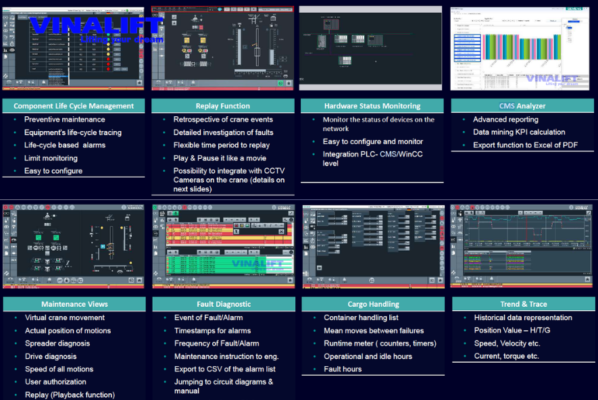
The CMS platform enables EPC contractors to transition toward predictive maintenance. Based on accumulated wire rope damage data in accordance with ISO 12482, engineers can schedule major overhauls during planned furnace shutdowns with greater accuracy, helping optimize operating expenditure (OPEX)
Global OEM Partnership Model
Importing complete ultra-heavy crane systems from Europe typically extends project schedules to 12–18 months due to maritime logistics constraints. Today, one of the most effective ways to optimize heavy-duty crane procurement schedules is an OEM localization partnership model for structural steel fabrication.
Under this model, primary load-bearing steel structures are manufactured domestically at VINALIFT’s ISO 9001:2015-certified crane manufacturing plant using CNC cutting, automated welding to achieve full-penetration welds, 100% NDT inspection (UT/MT) for key load-bearing joints, and Sa 2.5–Sa 3.0 surface preparation.
Meanwhile, high-value core components are specified for direct import from leading brands listed in the Approved Vendor List (AVL):
- Motors & Variable Frequency Drives (VFDs): Siemens (Germany) Sinamics S120 drives with Active Front End (AFE) regenerative technology, or ABB (Switzerland).
- Gearboxes: Flender (Germany) or Sumitomo (Japan).
- Braking Systems: Pintsch Bubenzer (Germany) or Stromag.
- Heat-Resistant Wire Ropes: Casar (Germany) or Teufelberger (Austria), utilizing Independent Wire Rope Core (IWRC) construction for high-temperature applications.
- Hook Blocks & Sheaves: Laminated hooks manufactured from riveted steel plates to reduce the risk of microscopic crack propagation.
Implementation Results: Shorter Lead Time and Localized Support
This approach reduces manufacturing lead time to six to eight months, shortening the procurement schedule by approximately 50%, while reducing bulky international transportation costs and ensuring on-site emergency technical support and spare parts availability within 24 hours.
For international EPC contractors, selecting lifting equipment for a metallurgical plant is not simply a matter of optimizing initial capital expenditure (CAPEX). It is a decision that protects personnel safety, commissioning milestones, and the project’s cash flow.
Contact VINALIFT’s engineering team to receive in-depth technical documentation and a crane design solution tailored to your project.
Hotline: (+84) 39 341 6686
Email: contact@vinalift.vn
