


Ladle Crane Project References for EPC Contractors
Jun
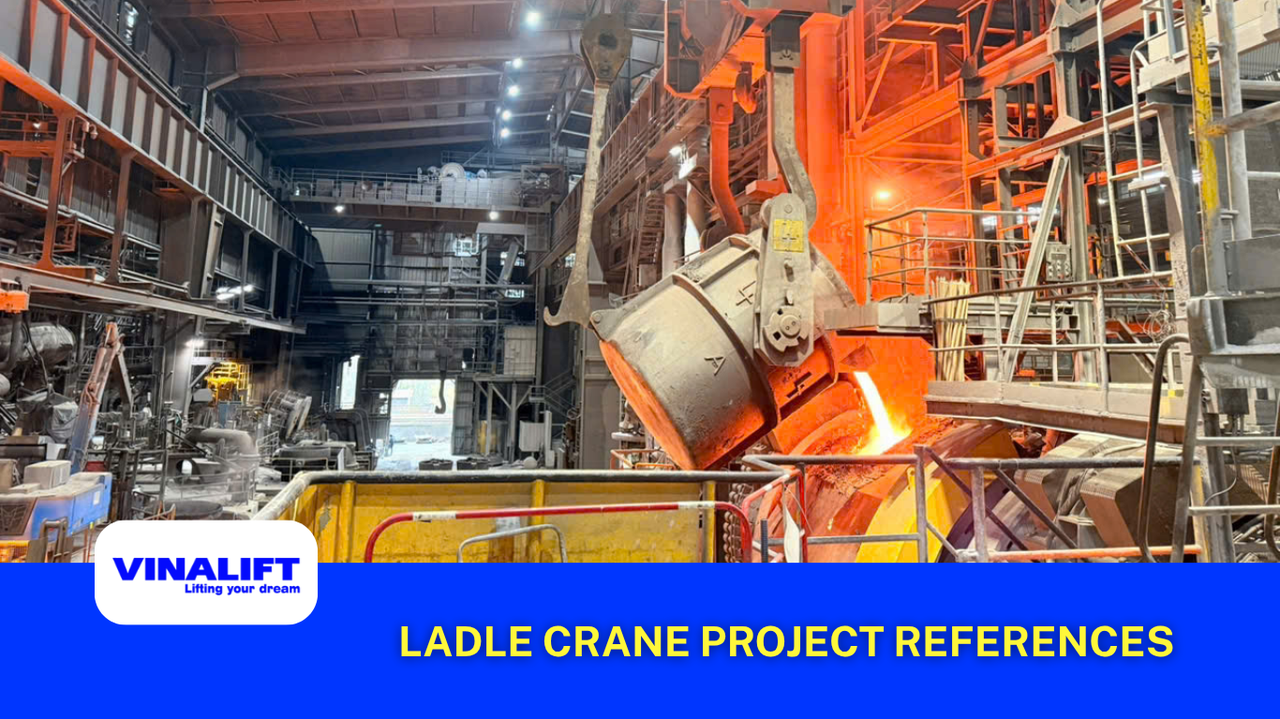
For EPC contractors in heavy industry, the greatest risk extends beyond project delays. It also includes unexpected production shutdowns caused by unreliable lifting equipment. In the harsh environment of steelmaking, where conductive dust and intense thermal radiation are constant challenges, any failure during molten steel handling can lead to catastrophic consequences for both personnel and plant assets.
A supplier’s credibility cannot be built on theoretical claims alone. Real ladle crane project references from successfully completed metallurgical projects provide stronger evidence of proven capability in large-capacity girder design, manufacturing quality, and safe on-site installation.
The role of the ladle crane project references for EPC contractors
For large-scale steel plant construction projects, selecting a lifting equipment supplier is one of the most critical engineering decisions made by an EPC project team. Unlike conventional industrial lifting equipment, a steel plant crane operates under extremely demanding conditions, continuously exposed to high temperatures, electrically conductive abrasive dust, and constantly changing dynamic loads.
A poor supplier selection can result in recurring equipment failures, prolonged production downtime, rapidly increasing maintenance costs, and, most importantly, serious safety risks caused by wire rope failures or braking system malfunctions.
Therefore, Ladle Crane Project References from projects that have been successfully commissioned and operated provide the most convincing evidence of a manufacturer’s engineering expertise, manufacturing capability, and ability to solve complex mechanical and electrical challenges.
Metallurgical plant operating environment
A steel mill is one of the harshest industrial environments in the world. Every metallurgical crane operating in these facilities must withstand five major operational hazards throughout its service life.
- Extreme Temperature and Direct Thermal Radiation: The ambient temperature beneath the workshop roof typically ranges from 40°C to 70°C. When a ladle crane handles molten steel at temperatures between 1,500°C and 1,600°C, intense thermal radiation is directly transferred to the underside of the main girder, the hook assembly, and the wire rope system.
- Abrasive Metallic Dust and Conductive Graphite Dust: Charging and melting operations generate large quantities of hard metallic particles together with highly conductive graphite dust. These contaminants can easily penetrate electrical cabinets, causing short circuits and accelerating wheel wear.
- Corrosive Gases and High Humidity: Steelmaking processes release sulfur compounds and nitrogen oxides that combine with moisture to create a mildly acidic atmosphere. This environment accelerates corrosion of structural steel components and oxidation of electrical connections.
- Continuous Heavy Vibration: Lifting hundreds of tonnes of molten steel and repeated impact loading during scrap charging generates severe torsional stresses and dynamic forces throughout the entire heavy-duty overhead crane structure.
- Continuous 24/7 Production: Steel plants operate continuously without interruption. Every hour of production lost because of a failed steel mill crane can result in financial losses worth hundreds of thousands of US dollars.
Proven engineering capability through VINALIFT’s major projects
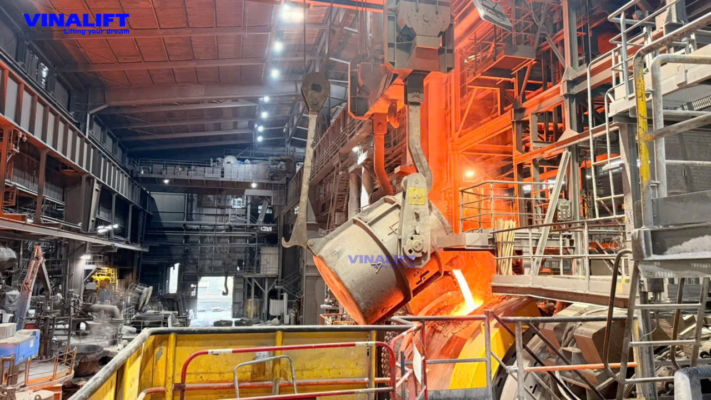
Rather than relying on theoretical commitments, VINALIFT has demonstrated its engineering capability through FEM 1.001 design standards for metallurgical crane-completed projects that meet the demanding requirements of the steel industry.
Representative projects include:
Magnetic lifting systems and Billet and coil handling crane solutions for major metallurgical complexes, designed for future integration with intelligent Crane Monitoring Systems (CMS) to optimize operating expenses and support predictive maintenance.
Design standards for metallurgical cranes
To achieve the highest level of operational safety, custom overhead cranes designed for steel production must comply with internationally recognized heavy-duty crane standards rather than conventional industrial crane specifications.
For EPC project managers, evaluating a supplier’s project references should not stop at the number of completed projects. It is equally important to verify whether the delivered systems achieve FEM A8 duty classification under FEM 1.001, or the equivalent M8 mechanism classification under ISO 4301. This technical classification determines whether a crane can operate reliably for more than 20 years or begin developing fatigue cracks in its box girder structure after only 3-5 years of service.
To eliminate these risks, EPC contractors should require single-failure proof redundant load path and high-temperature mechanical designe manufacturers to comply with internationally recognized standards for heavy-duty lifting equipment. The two most widely adopted standards are FEM 1.001 and CMAA Class F.
FEM 1.001 Design Standards for Metallurgical Cranes
The greatest difference between a conventional industrial crane and a steel mill crane lies in its fatigue life. Under FEM 1.001, crane classification is determined by two fundamental parameters:
- Utilization Class (U): For steel mills, the crane should meet Utilization Class U8 or U9, corresponding to more than 2 x 10^6 operating cycles throughout its design life.
- Load Spectrum (Q): A ladle crane always operates under Q4 (Very Heavy) load conditions. The empty ladle itself typically accounts for 40–50% of the crane’s Safe Working Load (SWL). When filled with molten steel, the actual lifting load continuously reaches 90–100% of the rated SWL.
The combination of Utilization Class U8/U9 and Load Spectrum Q4 results in a crane classified as FEM A8 (equivalent to ISO 4301 M8). Structural design and load calculations shall comply with EN 13001.
Single-failure proof redundant load path and high-temperature mechanical design
The hoisting mechanism should incorporate a single-failure-proof design with a redundant load path in accordance with EN 13135. This ensures that the failure of a single critical load-bearing component does not result in an uncontrolled load drop. If a wire rope, gearbox output shaft, coupling, or primary brake path fails, the crane must still be capable of holding the suspended load and lowering it in a controlled manner.
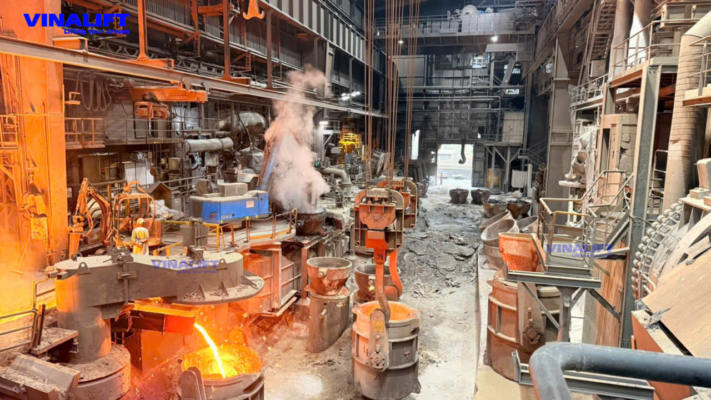
In addition, to protect the crane from direct thermal radiation generated by molten steel at 1,600°C, multilayer heat shields should be installed beneath the main girder. These shields consist of stainless steel protection plates combined with 50–100 mm thick ceramic fiber insulation. All hoisting wire ropes should use Independent Wire Rope Core (IWRC) construction to help reduce the risk of failure associated with conventional fiber-core wire ropes under high-temperature operating conditions.
Two-Tier Braking System and Dual Redundant Wire Rope Design
The hoisting mechanism of a double girder ladle crane must incorporate a two-tier braking system consisting of two completely independent braking stages.
- Service Brakes: The primary braking system normally consists of two independent disc brakes or electro-hydraulic thruster brakes mounted on the high-speed shaft of the hoisting motor. Each brake should provide a minimum braking torque equivalent to 150% of the rated motor torque.
- Emergency Caliper Brake: The emergency braking system uses large hydraulic caliper brakes mounted directly on the rope drum flange. If a gearbox output shaft fractures or the mechanical coupling fails, the emergency brake immediately locks the rope drum, preventing the molten steel ladle from falling freely.
The operational safety of a steel plant crane used for lifting molten steel, billets, and steel coils is further enhanced by an Equalizer Bar equipped with an Imbalance Detection System. When one wire rope fails, the equalizer bar tilts automatically, activating the safety limit switch and sending an emergency shutdown signal to the PLC within 10 milliseconds.
Control system design
Modern crane engineering has shifted from purely mechanical reliability toward intelligent automation. PLC-based crane control, anti-sway algorithms, CMS, and absolute positioning allow charging crane and ladle crane systems to improve operational efficiency while minimizing operator error.
Anti-Sway control system and absolute positioning
When transporting molten steel weighing hundreds of tonnes at heights of approximately 20 metres, the suspended load naturally behaves like a giant pendulum because of its enormous inertia. To suppress load swing, manufacturers implement a sensorless anti-sway control system using mathematical algorithms embedded directly within the Variable Frequency Drive (VFD) and PLC.
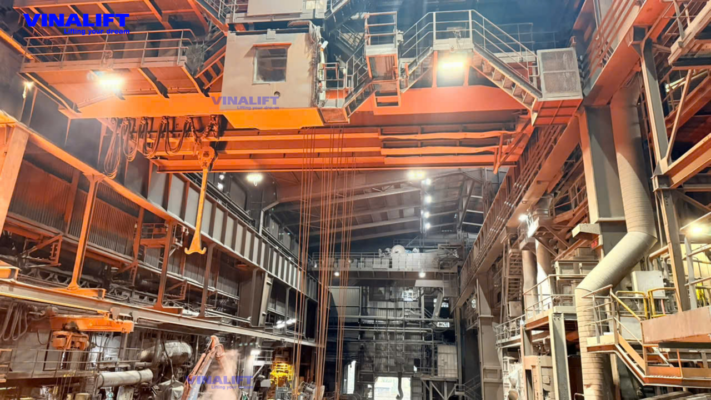
Automated crane operation also requires an absolute positioning system. A Barcode Positioning System (BPS) installed along the workshop can provide a positioning accuracy of ± 1mm to ± 5mm, enabling semi-automatic operation and allowing the ladle crane to position the molten steel ladle precisely above the furnace.
CMS and predictive maintenance
The Crane Monitoring System (CMS) communicates directly with the plant-wide SCADA/MES network through industrial communication protocols such as Profinet and Modbus TCP. CMS collects real-time data from load cells, rotary encoders, and motor temperature sensors to calculate the Safe Working Period (SWP) in accordance with ISO 12482.
As a result, the operation management team can monitor the remaining fatigue life of wire ropes and gearboxes in real time while scheduling predictive maintenance with greater accuracy, reducing unnecessary periodic replacement of components.
Manufacturing capability and quality certifications
To satisfy the stringent requirements of international EPC contractors, a crane manufacturing facility certified under ISO 9001:2015 for quality management should possess comprehensive in-house precision manufacturing capabilities, including:
- CNC cutting systems and automatic submerged arc welding (SAW) equipment capable of producing full-penetration welds.
- Non-Destructive Testing (NDT), including 100% Ultrasonic Testing (UT) and Magnetic Particle Testing (MT) for all primary load-bearing connections.
- Surface preparation using a blasting chamber meeting Sa 2.5 requirements and a high-performance C5 anti-corrosion coating system in accordance with EN ISO 12944.
With comprehensive production infrastructure and internationally recognized quality certifications, VINALIFT is well-positioned to deliver high-quality custom overhead crane solutions for demanding industrial projects. This enables VINALIFT to serve EPC contractors that require reliable engineering, controlled manufacturing quality, and responsive on-site technical support.
Conclusion
For large-scale EPC projects, metallurgical crane systems are far more than material handling equipment. They are critical assets that directly affect the continuity and reliability of the entire production line. Carefully evaluating ladle crane project references from technically capable Vietnam-based manufacturers such as VINALIFT helps EPC contractors optimize initial capital expenditure (CAPEX) while maintaining strict safety requirements, manufacturing schedules, and 24/7 on-site technical support.
Contact VINALIFT’s engineering team to receive in-depth technical documentation and a crane design solution tailored to your project.
Hotline: (+84) 39 341 6686
Email: contact@vinalift.vn
