


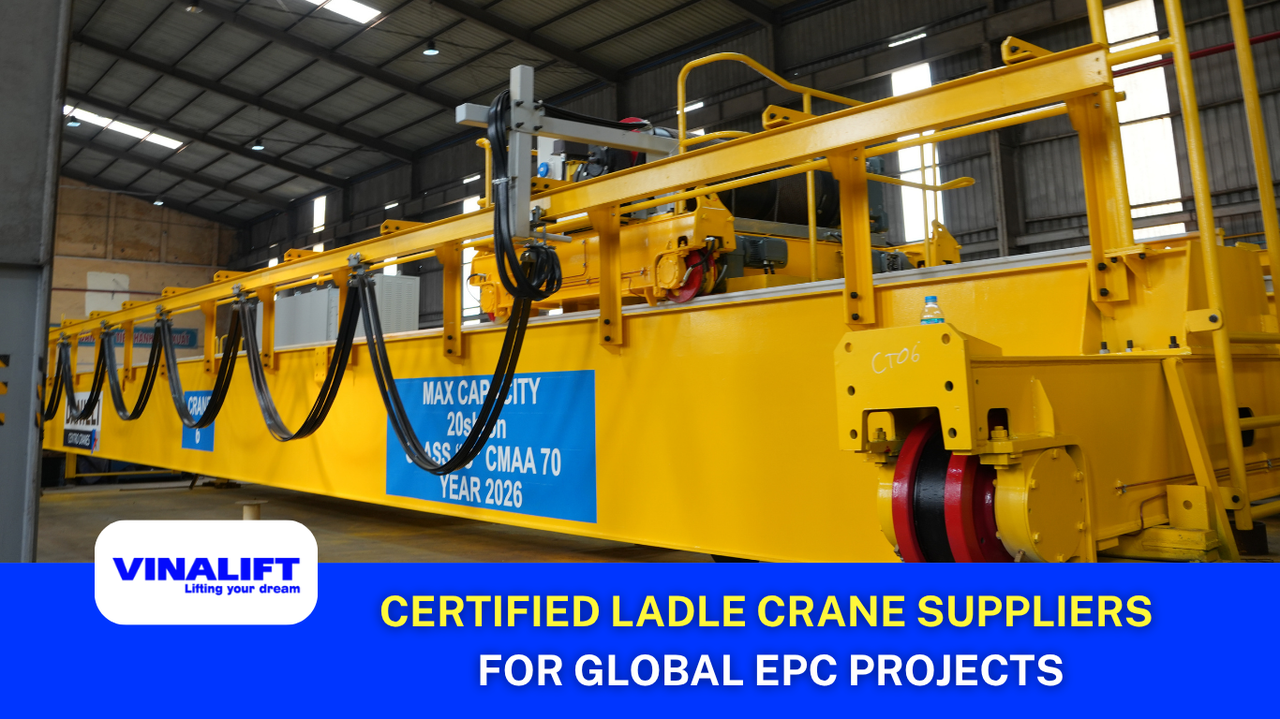
Certified Ladle Crane Suppliers for Global EPC Projects
Jul
In this context, a certified supplier is a manufacturer whose relevant management systems, manufacturing processes, welding qualifications, and inspection procedures have been independently assessed against the applicable project requirements. Certification should always be reviewed together with its scope and validity.
Selecting lifting equipment for metallurgical applications involves significant technical, safety, and project-execution risks. A design deficiency, manufacturing nonconformity, or unplanned ladle crane outage may affect commissioning, production ramp-up, and the overall handover schedule of a steel plant.
Operational challenges in steel plants
The meltshop is one of the harshest industrial environments. A general-purpose industrial crane that has not been engineered for meltshop conditions may experience accelerated degradation of structural, mechanical and electrical components. For EPC contractors, understanding these operating hazards is the first step in evaluating the capabilities of a vendor.
Extreme temperature and infrared thermal radiation
The ambient temperature beneath the roof of a steel plant, where the crane operates, typically ranges from 40°C to 70°C due to heat generated by Electric Arc Furnaces (EAF). However, thermal radiation emitted by molten steel at temperatures between 1,500°C and 1,600°C is the most destructive factor. This intense radiant heat is directed toward the underside of the crane girder, the hook assembly, and the wire ropes.
Based on the measured ambient temperature, radiant heat exposure and required crane availability, the design may incorporate heat-resistant wire ropes and lubrication, insulated heat shields, protected cable routing and enhanced cooling for electrical rooms and operator cabins. Where continuous operation is critical, a redundant cooling configuration may also be specified.
Abrasive dust, graphite dust, and corrosive gases
Charging, melting, and steel pouring processes generate large quantities of highly abrasive slag particles together with conductive graphite dust. Steel slag accelerates mechanical wear on crane wheels and rails, while graphite dust from furnace electrodes can accumulate on VFD circuit boards inside unsealed electrical cabinets, causing short circuits and electrical fires.
Electrical cabinets, motors and field devices should be specified with ingress protection ratings appropriate to the installation area, contamination level and maintenance conditions. The supplier’s ISO 9001-certified quality management system should provide controls to ensure that these project requirements are consistently implemented and verified. The electrical room should maintain positive air pressure, while travelling wheels should be fitted with heavy-duty steel rail scrapers to remove steel slag from the runway before wheel contact.
Duty Classification and Applicable Design Standards
Crane classification should be determined from the expected operating duty rather than assigned solely according to the crane application.
The assessment should consider the total number of working cycles over the specified design life, the load spectrum, the frequency of full-load lifts, average load displacement, the number of operating shifts, and the required production cycle.
FEM 1.001 may be applied where it is specified in the project design basis. Depending on the contractual requirements and destination market, ISO 4301, EN 13001 or other applicable standards may also be required.
Ladle cranes frequently operate under high utilization and severe load conditions. However, classifications such as A8, U8, U9, or M8 should only be stated after the project duty data have been evaluated and documented.
Critical safety mechanisms for double-girder and four-girder ladle crane systems
Redundant Hoisting Architecture for Single-Failure Risk Control
In accordance with EN 13135 for crane equipment safety, ladle crane hoisting systems should incorporate a single-failure-proof design with a redundant load path for molten-metal handling applications. Depending on the project safety requirements and risk assessment, the hoisting system may incorporate independent or redundant load paths, multiple braking devices, rope-tension monitoring, overspeed protection and safety-related control functions.
The system adopts an independent Dual-Rope Reeving System.
Where independent rope paths are provided, the remaining load path should be designed to control or retain the load following the failure of one path, in accordance with the approved safety concept.
Rope-tension or imbalance monitoring can be integrated into the safety control system to detect abnormal conditions and initiate the defined protective response.
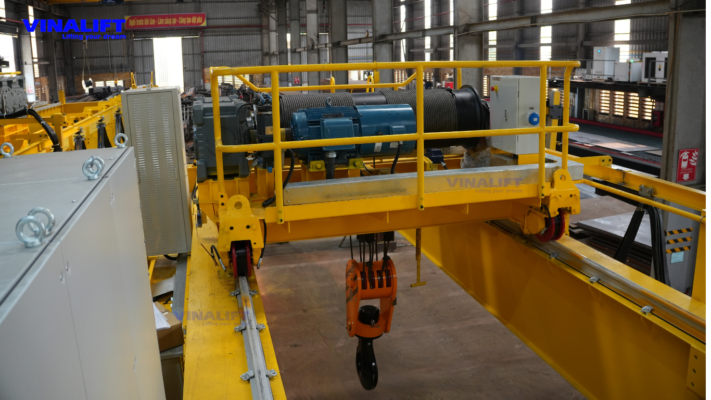
The Equalizer Bar connecting both wire ropes incorporates an Imbalance Detector. When unequal rope tension caused by rope breakage or jamming is detected, the PLC immediately issues an Emergency Stop (E-STOP) command within less than 10 milliseconds.
Braking system and laminated hook assembly
To prevent uncontrolled load descent caused by gearbox output shaft failure, For molten-metal handling applications, the braking architecture should be selected according to the hoisting configuration, crane duty, and project risk assessment. A high-safety system may incorporate service brakes on the high-speed side together with an additional emergency brake acting on the rope drum or another suitable low-speed component.
- Level 1 (Service Brakes): At least two independent disc brakes or drum brakes are installed on the high-speed shaft of the hoisting motor.
- Level 2 (Emergency Brakes): Hydraulic Caliper Brakes acting directly on the Rope Drum Flange. This braking system operates independently and automatically engages by spring force upon loss of hydraulic pressure (Fail-Safe Principle), The emergency brake provides an additional means of controlling the load if a critical failure occurs within the primary drive or transmission system. Where specified, it should be spring-applied and fail-safe upon loss of electrical or hydraulic power.
The crane utilizes a Laminated Hook assembled from multiple profiled steel plates that are tightly compressed and riveted together. The laminated construction can help limit crack propagation to an individual plate and make certain forms of damage more visible during inspection. Any detected crack, deformation or other defect must be assessed immediately in accordance with the approved inspection and maintenance procedure.
Smart crane automation technology
In modern industrial projects, EPC contractors evaluate cranes based not only on lifting capacity and span but also on their ability to integrate intelligent automation, reduce operating cycle time, and improve operational safety. These capabilities have become key selection criteria during equipment procurement.
Sensorless anti-sway system
When transporting molten steel ladles weighing hundreds of tonnes, inertia creates significant pendulum motion, increasing the risk of molten steel spillage. A sensorless anti-sway function may be implemented through the PLC, variable frequency drives or a dedicated motion-control platform. The control algorithm uses crane-motion and hoisting data to optimize acceleration and deceleration profiles. Using the actual wire rope length obtained from the hoisting motor encoder, the control algorithm automatically optimizes acceleration and deceleration profiles.
As a result, the suspended load stabilizes rapidly while sway is effectively minimized without requiring optical sensors. This solution is particularly suitable for metallurgical environments characterized by heavy dust, high temperatures, and demanding reliability requirements.
Absolute positioning system and PLC-based no-fly zone management
Wheel slippage caused by oil contamination on crane rails often results in cumulative positioning errors when conventional relative positioning systems are used. Where accurate and repeatable crane positioning is required, an absolute positioning system may be installed along the runway. Depending on the selected technology and installation conditions, the position data can be integrated into the PLC to establish restricted travel zones, reduced-speed zones and equipment interlocks. These real-time positioning data allow the PLC to establish virtual No-Fly Zones (Zone Interlocking) throughout the plant. Charging crane and ladle crane systems automatically stop or reduce travelling speed when entering sensitive areas such as central control rooms, electrical substations, or worker walkways.
Predictive maintenance
A Crane Management System can collect load, cycle, drive, brake and event data to monitor actual crane duty against the original design duty. In accordance with ISO 12482, these data can support the assessment of the crane’s approach to its design working period and help focus inspections on critical areas.
Component condition and replacement intervals must still be determined through physical inspections, applicable rejection criteria and manufacturer recommendations. These functions can support maintenance planning and reduce the risk of unplanned downtime.
Selection criteria for certified ladle crane suppliers for global EPC projects
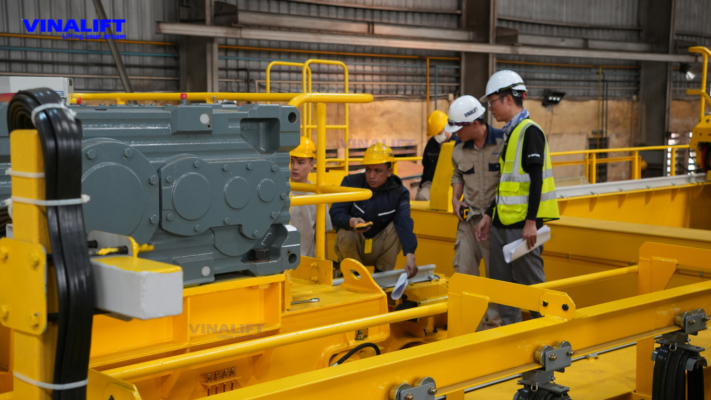
To reduce technical and execution risks while protecting the EPC project schedule, supplier evaluation should be based on the following criteria:
- Manufacturing quality and welding control: The supplier should maintain an ISO 9001-certified quality management system with a scope relevant to crane design, manufacturing and project execution. The EPC contractor should also review the supplier’s welding quality system, approved WPS and PQR records, welder qualifications, material traceability, NDT procedures and Inspection and Test Plan. Where specified, compliance with ISO 3834 or an approved equivalent may also be required.
- Custom engineering capability: The supplier shall possess extensive experience in designing heavy-duty crane girders and specialized lifting equipment, including double girder ladle crane systems, Billet and coil handling crane systems, and heavy-duty suspension cranes serving furnace maintenance areas.
- Capability to integrate internationally recognized core components: System integration capability: Motors, gearboxes, brakes, drives, encoders, and control equipment should be selected according to the crane duty, project specification, and approved vendor list. Internationally recognized brands may be proposed together with technically approved equivalents. The evaluation should consider system compatibility, spare-parts availability, service coverage, lifecycle support and obsolescence management.
- Experience with major industrial projects: The supplier should demonstrate a defined site-support and escalation plan, including agreed response times, mobilization conditions, commissioning responsibilities and access to critical spare parts.
- Project Execution and Schedule Control:
- For an EPC Project Director, supplier qualification must include execution capability as well as technical capability. The supplier should provide an engineering and document-submission schedule, a procurement plan for long-lead components, manufacturing milestones, an Inspection and Test Plan, a FAT programme, a logistics plan, an erection and commissioning method statement, and a handover-documentation schedule.
- A technically capable supplier may still create project risk if drawings, calculations, components or approval documents are delivered late.
- Testing, Commissioning and Handover Documentation:
The supplier should define the verification process before manufacturing begins. The scope may include material inspection, welding inspection, NDT, dimensional checks, electrical testing, brake testing, functional testing, safety-function validation, load testing, FAT, SAT and operator training.
The final handover dossier should include approved drawings, calculations, material certificates, inspection records, test reports, operation and maintenance manuals, spare-parts lists and as-built documentation.
Selected VINALIFT Steel-Industry Crane References
Projects delivered across domestic and international steel industries demonstrate VINALIFT’s comprehensive capability to satisfy the demanding requirements of EPC contractors. From engineering designs tailored to each plant’s production technology and operating conditions, to manufacturing processes controlled under a certified quality management system, and the integration of internationally recognized core components, VINALIFT has delivered heavy-duty overhead crane solutions for steel-industry projects in Vietnam and international markets. The following selected references demonstrate experience in engineering and supplying crane systems for demanding industrial environments.
- Steel Industry – 80/20T Double Girder overhead crane – Hoa Phat Dung Quat Integrated Iron and Steel Complex
- Steel Industry – 40/10T Double Girder overhead crane – Steel Plant, Argentina
Conclusion
The reliability and safety of metallurgical crane systems form the backbone of both productivity and personnel safety in steel plants. Selecting certified ladle crane suppliers for global EPC projects with advanced engineering expertise and internationally certified quality management systems represents the strongest commitment to the success of your next heavy industrial project.
Contact the VINALIFT engineering team to receive in-depth technical documentation and the most suitable engineering solution for your project.
Hotline: (+84) 39 341 6686
Email: contact@vinalift.vn
