


Industrial Crane Supplier Standards for Reducing EPC Project Risk
Jul
Managing risk in lifting equipment procurement is one of the most critical challenges in EPC projects. In the harsh operating environment of steel plants, even a minor lifting equipment failure can delay project schedules, damage assets, and expose stakeholders to serious legal and safety risks.
This article from VINALIFT explains why compliance standards and supplier qualification criteria are essential when selecting industrial crane vendors. These criteria help EPC managers identify suppliers capable of designing heavy-duty overhead crane systems that meet international standards and reduce potential legal, technical, and operational risks.
EPC contractor responsibilities
In large-scale steel plant construction projects, lifting equipment packages are always classified as one of the highest-risk procurement categories by Project Directors. When a serious technical incident involves a steel plant crane—particularly ladle crane systems handling molten metal—legal responsibility is not limited to the equipment vendor. It can also extend directly to the EPC contractor.
EPC contractors are responsible for design review, manufacturing quality supervision, load testing, commissioning verification, and statutory safety inspection before the crane is put into service. Selecting vendors that lack the required legal qualifications, certified engineering capabilities, or that reduce costs by using materials of unknown origin exposes the project to significant legal risk.
Understanding and rigorously applying compliance standards and supplier qualification criteria, therefore, serves as an effective technical safeguard for reducing these risks during the tendering stage.
Mandatory Technical Considerations for Steel Plants
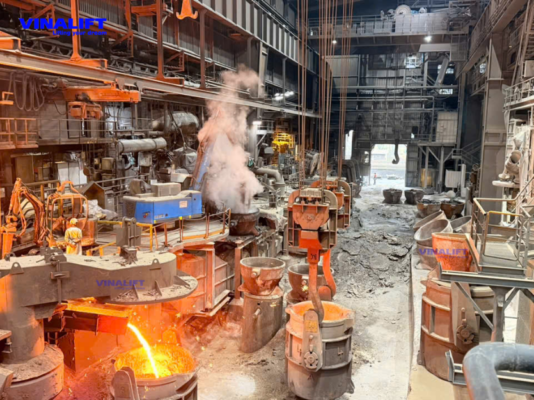
The metallurgical environment presents one of the most demanding operating conditions for mechanical and electrical equipment. To prevent structural failures or control system fires in steel mill crane applications, steel plants should require suppliers to comply with the following technical requirements.
Controlling Temperature and Thermal Radiation from Molten Steel Ladles
- Heat-resistant wire ropes are mandatory: Conventional fiber-core wire ropes must never be used because lubricant ignition, embrittlement, and rope failure may occur under thermal radiation from molten steel ladles. Steel plants should require Independent Wire Rope Core (IWRC) heat-resistant wire ropes.
- Installation of heat shields: The bottom section of the main girder on both charging crane and ladle crane systems must incorporate multi-layer heat shield assemblies to isolate radiant heat and maintain the structural steel within a safe operating temperature range.
- Redundant cooling system for the electrical room (E-room): Steel plants should require heavy-duty industrial air-conditioning systems operating in a 1+1 redundancy configuration. If one unit fails, the standby unit must automatically start to keep the electrical room within the allowable operating temperature range of the installed PLCs, VFDs, and control equipment.
Preventing short circuits caused by conductive dust
- Electrical enclosure protection rating (IP): Graphite dust generated by Electric Arc Furnaces (EAF) is highly conductive. Steel plants should not accept open electrical cabinets. All electrical enclosures housing PLCs and VFDs must provide a minimum protection rating between IP54 and IP66.
- Positive pressure solution: The ventilation or air-conditioning system serving electrical rooms and electrical cabinets must incorporate a positive pressure system that continuously supplies filtered clean air to prevent conductive dust from entering through enclosure openings, thereby avoiding short circuits and fire hazards.
Protecting against chemical corrosion and acid mist
- High-performance protective coating system: Furnace fumes contain SO2 and NOx, which, combined with moisture, create acid mist that causes rust and destroys steel structures very quickly. Steel plants should specify a high-performance anti-corrosion coating system, such as C3, C4, or C5 corrosivity categories under ISO 12944, in their tender documents.
- Mandatory coating procedure: All structural steel surfaces must be blast-cleaned to the required standard (typically Sa 2.5) before coating. The standard coating system shall include a zinc-rich epoxy primer combined with a polyurethane (PU) topcoat to provide chemical resistance and withstand the aggressive steel plant environment.
Projects delivered by VINALIFT:
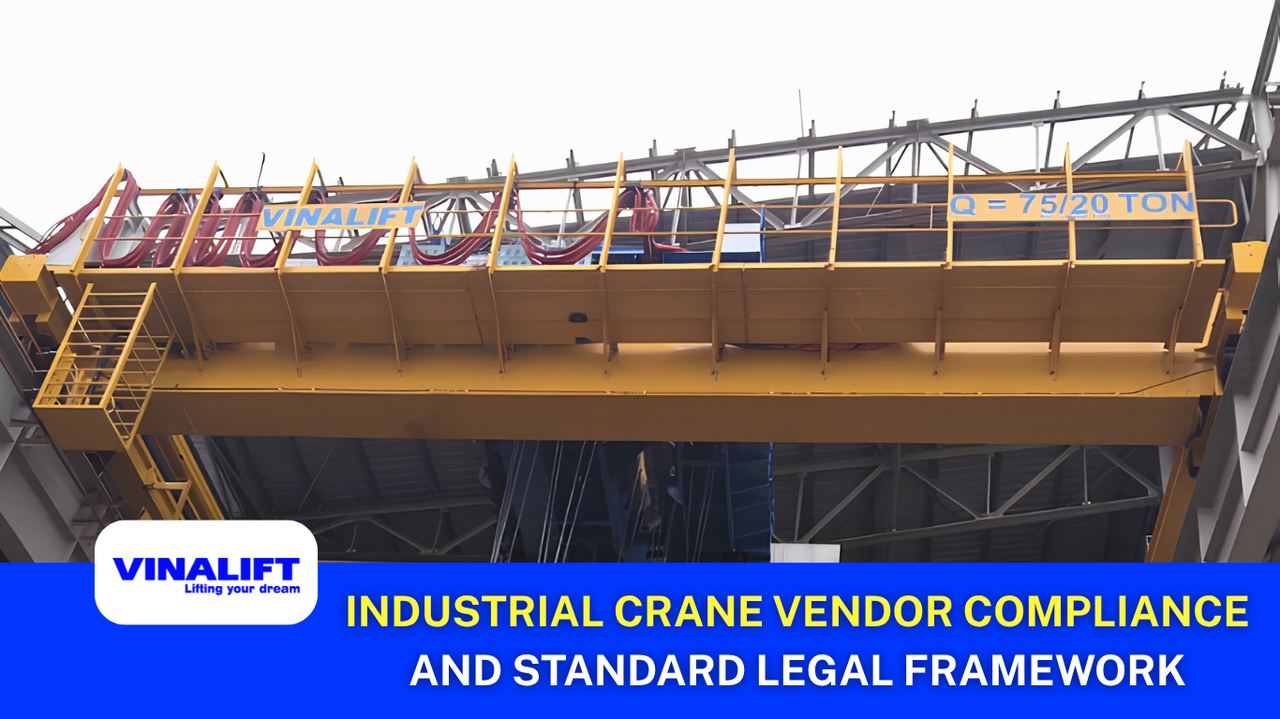
- Steel Industry – 75/20T ladle crane – Hoa Phat Steel Plant
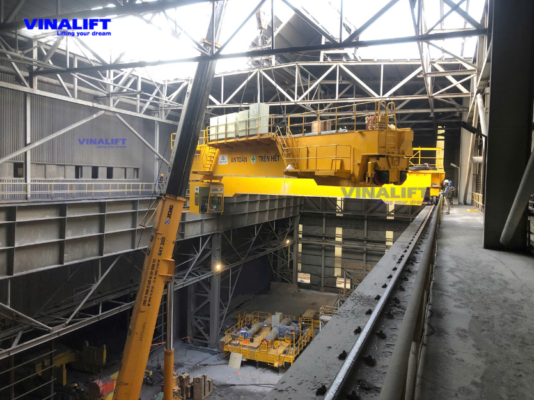
- Steel Industry – 40/10T Double Girder overhead crane – Danieli Steel Plant, Argentina
Fatigue design standards and self-weight optimization for crane suppliers
Design standards
To satisfy the demanding operating conditions of steel plants—including the handling of molten steel ladles, billets, and steel coils – crane suppliers must strictly comply with the following fatigue life requirements.
- Highest design classification (A8/M8) is mandatory: Due to continuous 24/7 operation and Load Spectrum Class Q4, the crane should be specified for FEM A8 duty classification under FEM 1.001, with equivalent mechanism classification under ISO 4301 M8 where applicable. Structural design and load calculations should be performed in accordance with EN 13001.
- Girder manufacturing standards:
- For ultra-heavy capacities ranging from 200 to over 500 tonnes, a four-girder layout configuration is mandatory to separate the operating spaces of the main trolley and auxiliary trolley.
- Crane girders adopt a box girder structure manufactured using Full Penetration Welds. All critical load-bearing welds must undergo ultrasonic testing (UT), with 100% UT applied where required by the approved inspection plan. Internal transverse stiffeners shall be installed at intervals of 1.0–1.5m to prevent torsional deformation and local buckling.
- Quality management certification:
- The manufacturing facility must be certified under ISO 9001:2015 for quality management to ensure consistent material traceability, welding control, and inspection procedures.
- The control system shall incorporate a Safe Working Period (SWP) calculation algorithm compliant with ISO 12482, automatically calculating fatigue life consumption using actual operating data collected from load cells and encoders to support occupational safety inspections.
Redundant Safety Systems for Load-Drop Prevention
The primary hoisting mechanisms of both charging crane and ladle crane applications must incorporate parallel redundant systems to prevent catastrophic load-drop incidents.
- Dual-Rope design standard: The rope drum shall contain dual grooves for two independent wire ropes reeved from opposite sides. Each independent rope path shall be designed with a safety factor not less than 4:1, or as required by the applicable crane safety standard, so that the remaining rope path can hold the suspended ladle under a defined single-failure condition. The equalizer bar shall incorporate imbalance detection limit switches to initiate emergency shutdown if rope breakage, inclination, or misalignment is detected.
- Redundant drive system: The hoisting drive should use two independent motors connected through a differential gearbox, where required by the risk assessment and project specifications. If one motor fails, the control system should switch to half-speed mode, allowing the molten steel ladle to be moved to a safe lowering position.
- Two-tier safety braking system:
- Level 1: Service Brakes installed on the motor high-speed shaft.
- Level 2: Emergency Caliper Brakes consisting of hydraulic disc brakes acting directly on the rope drum flange. The emergency brake is designed to lock the drum if the gearbox or coupling experiences catastrophic failure.
Intelligent Control System and Operational Management
To reduce errors caused by human operation and harsh environmental conditions such as dust, smoke, and wheel slippage on crane rails, suppliers should meet the following control system requirements.
- Absolute Positioning and No-Fly Zones: Conventional rotary encoders should not be relied on as the sole positioning method because they are susceptible to positioning errors caused by wheel slippage. Suppliers must integrate an Absolute Positioning System capable of maintaining positioning accuracy within ±1 mm to ±5 mm, with coordinates linked directly to the PLC to establish No-Fly Zones protecting substations and control rooms.
- Anti-Sway Technology Standard: This function is particularly mandatory for remotely operated overhead crane systems. The PLC shall integrate a Sensorless Anti-Sway algorithm that automatically adjusts the acceleration and deceleration profiles of the Variable Frequency Drive (VFD) according to the actual wire rope length, helping the load stop more precisely at its target position while suppressing swing caused by the inertia of the molten steel ladle.
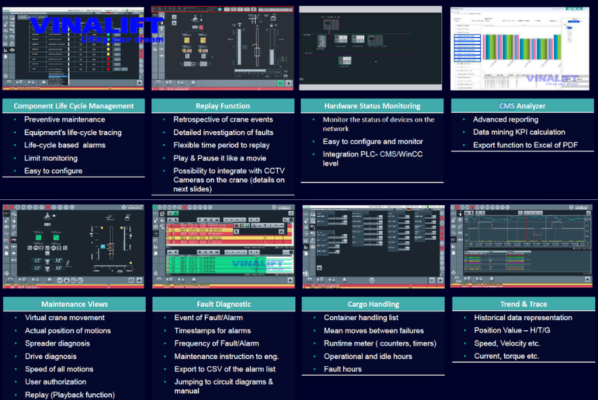
- Crane Management System (CMS): The equipment shall incorporate a CMS that continuously collects real-time operating data from sensors and displays it on the HMI. The system should support maintenance technicians in isolating and diagnosing faults within a target response time of five minutes, depending on the alarm logic and system configuration. Selecting a supplier with proven expertise in FEM 1.001, EN 13001, and ISO 12482 fatigue monitoring procedures is the only reliable engineering benchmark for protecting both project cash flow and the reputation of the EPC contractor.
Conclusion
In the metallurgical and heavy industrial sectors, even a minor mistake in evaluating the capabilities of a lifting equipment supplier can undermine every effort to ensure project safety and schedule performance. Selecting a supplier with proven expertise in FEM 1.001, EN 13001, and ISO 12482 fatigue monitoring procedures is a critical engineering benchmark for protecting project cash flow and the EPC contractor’s reputation.
As a Global EPC Partner, VINALIFT delivers more than standalone equipment. We provide risk-controlled crane solutions through non-standard customized engineering capability, manufacturing quality control, and responsible on-site technical support throughout project execution.
Contact VINALIFT’s engineering team to receive in-depth technical documentation and a crane design solution tailored to your project.
Hotline: (+84) 39 341 6686
Email: contact@vinalift.vn
