


Risk Management for Molten Steel Lifting in Metallurgical Plants
Jul
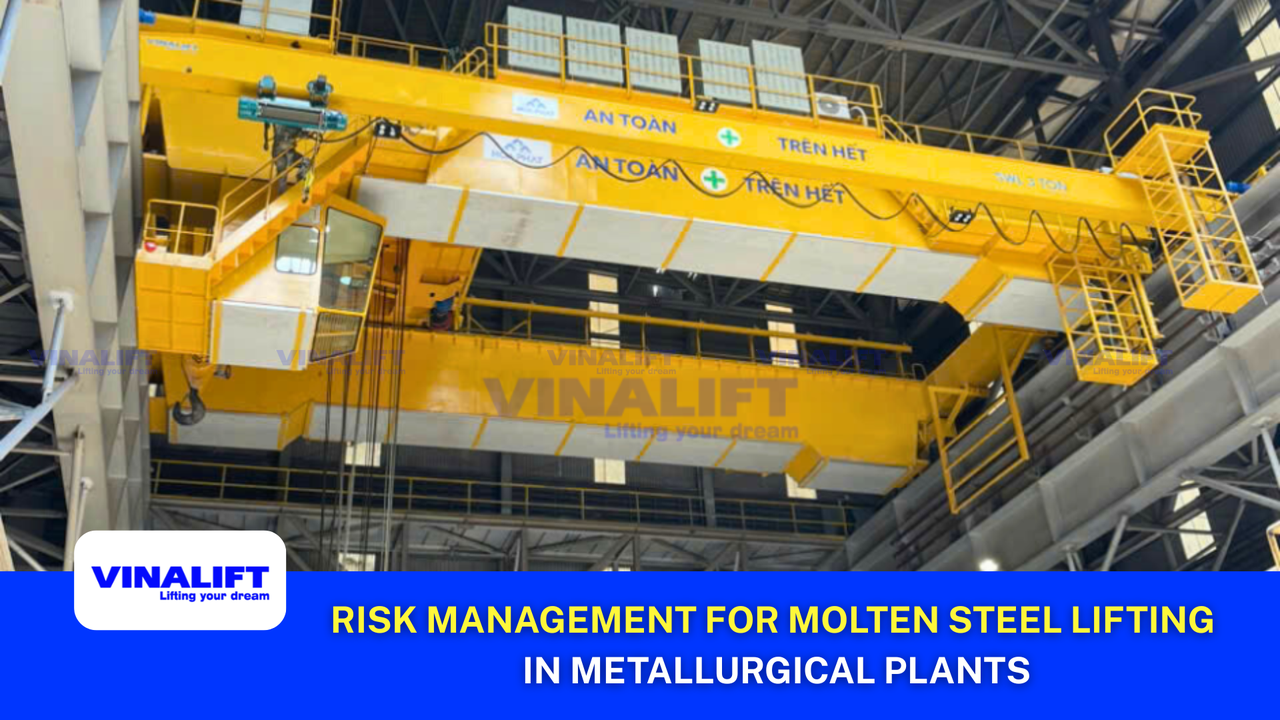
In modern metallurgical plants, the biggest risk does not lie in how many metric tonnes the crane can lift, but in its ability to control tens to hundreds of metric tonnes of molten steel throughout the entire travel process. A single incident such as loss of braking capability, hoisting rope breakage, rope drum overspeed, material fatigue, or degradation of load-bearing structures and mechanisms due to high temperature can lead to unplanned furnace shutdown, destruction of process equipment, production line interruption, and direct threats to human safety.
Therefore, risk management in molten metal cranes cannot rely only on operating procedures after the equipment has been installed. It must begin at the design stage: analyzing the working environment, load spectrum, operating cycles, duty class, redundant mechanisms, braking system, heat protection, and condition monitoring capability throughout the operating life cycle.
For ladle crane projects, the important question is no longer “How many metric tonnes can the crane lift?” but: if one critical component fails, can the system still control the molten steel ladle?
Quick summaryRisk management in molten steel lifting is the process of identifying, assessing, and controlling hazards that may lead to loss of load control when a crane transports a molten steel ladle in a metallurgical plant. The main risks include load drop or loss of load control, overheating, material fatigue, brake failure, power loss, drive mechanism failure, and insufficient operational monitoring.To control these risks, the solution cannot rely only on operating procedures. The system must be designed from the beginning with the appropriate duty class, redundant mechanisms, multi-layer braking system, heat protection, overspeed protection, load monitoring, brake-status monitoring, temperature and vibration data, and CMS/SCADA records for early warning and maintenance planning.
What is risk management in molten steel lifting?
Risk management in molten steel lifting is the process of designing, controlling, and monitoring the entire lifting system to limit the risk of losing load control when a crane transports a molten steel ladle. This process includes evaluating load, temperature, material fatigue, duty class, braking system, redundant mechanisms, monitoring devices, and emergency response procedures.
In a metallurgical plant, risk management is not only a safety requirement. It is also a condition for protecting the production line, reducing the risk of unplanned furnace shutdown, and helping EPC contractors select the right ladle crane solution from the design stage.
Key insight
In molten steel lifting, the greatest risk is not “how many tons can be lifted,” but “whether the system can still control the load when one critical component fails.”
Why is molten steel lifting one of the highest-risk tasks in a metallurgical plant?
Load drop, loss of braking capability, overheating, or drive mechanism failure during molten steel transport can lead to consequences far more severe than those in conventional lifting applications.
Within the same steel plant, steel mill crane systems used for lifting steel ladles, billets, and coils have very different risk levels. Cranes for handling billets and coils often need to deal with heavy loads, high duty cycles, and precise positioning requirements. Charging cranes and ladle cranes both operate in harsh metallurgical areas, affected by temperature, dust, vibration, and continuous operation.
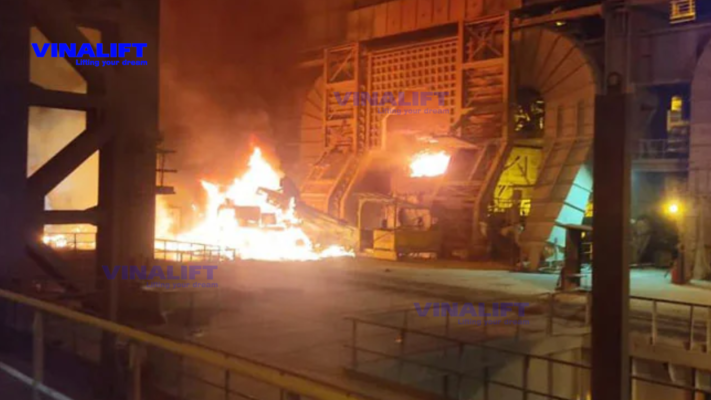
However, the ladle crane is the highest-risk category because it directly transports molten steel ladles at temperatures that may exceed 1,600°C. When the load is molten metal, an incident does not only damage lifting equipment but may create a chain of consequences: molten steel may spill onto the floor and, if it contacts cooling water or moisture, may trigger a steam explosion, damage surrounding equipment, and force an emergency shutdown of the production line.
For project owners and EPC contractors, the greatest risk is not the failure of one individual mechanism, but the loss of load control during transport. This is why every modern metallurgical crane project must be assessed for risk from the design stage, instead of adding safety equipment only after the system has been completed.
EPC should note
When evaluating a ladle crane, EPC contractors should not only ask about nominal lifting capacity. The more important question is: has the system been designed to handle scenarios such as loss of braking capability, rope breakage, overspeed, overheating, and material fatigue?
Main risk map in molten steel lifting
Risk management in molten steel lifting cannot be handled by one single safety device. It requires an integrated design architecture in which the steel structure, hoisting mechanism, brakes, hooks, electrical control, sensors, and operating procedures must be considered as one unified system.
|
Risk Group
|
Common Causes
|
Possible Consequences
|
Design Control Approach
|
|
Load drop
|
Rope breakage, brake failure, gearbox failure, drum overspeed, drive shaft destruction
|
Molten steel spills onto the floor, risk of steam explosion, equipment destruction
|
Redundant mechanisms, multi-layer brakes, overspeed protection, load monitoring
|
|
Overheating
|
Radiant heat from the molten steel ladle, high-temperature metallurgical environment
|
Reduced service life of ropes, sheaves, bearings, electrical equipment, and load-bearing structures
|
Heat shields, rope/sheave protection, cabin or electrical room insulation, suitable materials
|
|
Material fatigue
|
Continuous lifting cycles, heavy loads, vibration, impact
|
Fatigue cracking, structural destruction, reduced operating reliability
|
Classification according to load spectrum, fatigue life verification, design according to actual duty
|
|
Loss of control during power failure
|
Sudden system shutdown, control fault, signal fault
|
Suspended load is not controlled, difficult to bring the system back to a safe state
|
Safety brakes, fail-safe control logic, procedure for bringing the load back to a safe state
|
|
Failure not detected early
|
Lack of operating data, experience-based maintenance
|
Failure develops silently, unplanned downtime
|
CMS, load, temperature, vibration, brake status sensors, data transmitted to PLC/SCADA/MES
|
|
Incorrect design configuration
|
Incorrect duty class selection, incorrect hoisting mechanism, insufficient heat protection
|
Equipment degrades quickly, increases operating risk
|
Risk assessment from the design stage, benchmarking against FEM 1.001, EN 13001, EN 13135, and TCVN 4244:2005
|
Load drop is always considered the most serious scenario
Load drop is the most serious risk in molten steel lifting because it can cause molten steel to spill onto the floor, create a steam explosion, destroy equipment, and directly threaten human safety.
Throughout the operating life cycle of a ladle crane, load drop may originate from many different failure points: hoisting rope breakage, gearbox failure, loss of load-holding capability in the braking system, rope drum overspeed, drive shaft destruction, or degradation of load-bearing mechanisms after long-term operation in a high-temperature environment.
For conventional lifting applications, load drop is already a dangerous incident. But with a molten steel ladle, the consequences can go far beyond a single piece of equipment. When molten metal comes into contact with cooling water, moisture, or combustible materials in the metallurgical area, the risk of steam explosion, fire spread, and destruction of process equipment is very high.
Therefore, the design philosophy for a ladle crane cannot stop at “increasing the safety factor.” The system must be designed so that a single failure does not lead to loss of load-holding capability or uncontrolled load movement.
Read more: Multi-layer braking system protecting molten steel loads.
High temperature creates difficult-to-detect risks
High temperature is a silent factor that reduces the service life of hoisting ropes, sheave assemblies, bearings, hooks, lifting beams, cabins, electrical cabinets, and control devices on ladle crane systems.
Many people assume that load is the most dangerous factor for a metallurgical ladle crane. However, in a metallurgical environment, temperature is the silent factor that reduces the service life of many critical components.
Radiant heat from the molten steel ladle can simultaneously affect hoisting ropes, sheave assemblies, bearings, hooks, lifting beams, cabins, electrical cabinets, and control devices.Without proper protection, high temperatures can age lubricating grease, reduce rope service life, cause local deformation, affect insulation materials, and accelerate thermal fatigue in load-bearing components.
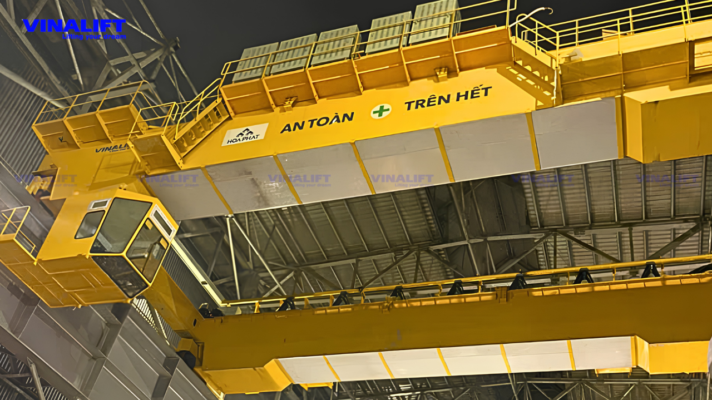
That is why ladle crane systems usually must be designed with radiant heat shields, specialized lifting beams, rope and sheave protection solutions, and insulation measures for cabins or electrical rooms. For large-capacity crane girder design, the issue is not only instantaneous deflection, but also structural stability, torsional resistance, and fatigue life over millions of operating cycles.
From a risk management perspective, temperature control is not an auxiliary item. It is a core part of the strategy for protecting the load, protecting equipment, and protecting people in the metallurgical area.
See more: Ladle Crane Acceptance Testing Procedure for EPC.
Material fatigue failure is a silent threat
Material fatigue is dangerous because it usually develops over a long period, is difficult to detect through normal observation, but can lead to structural cracking or destruction of load-bearing mechanisms if not calculated from the beginning.
Unlike mechanical failures that appear suddenly, material fatigue usually develops over a long period before creating serious failure. Components such as hooks, lifting beams, drums, drive shafts, wheels, main girders, and welded joints are continuously subjected to repeated loads throughout the equipment life cycle.
In metallurgical plants, this issue becomes more serious because loads are usually heavy, operating cycles are high, and the environment involves high temperature, vibration, and continuous impact. If the equipment is not properly classified according to actual load spectrum and utilization frequency, micro-cracks may form, develop gradually, and eventually lead to fatigue cracking or structural destruction.
Therefore, when designing a double girder ladle crane or large-capacity metallurgical crane configurations, engineers do not only check static load-bearing capacity. The system must be evaluated according to duty class, load spectrum, operating cycles, dynamic load combinations, and fatigue life of each critical mechanism.
Risk management must begin from design
Many serious risks in molten steel lifting cannot be handled only through operating procedures; they must be controlled from the crane design stage.
A common assumption in many projects is that strict operating procedures are enough to ensure safety. However, with a *ladle crane*, many serious risks must be eliminated or controlled from the design stage.
At this stage, the engineering team must clearly determine where the equipment will operate, what type of load it will lift, how frequently it will operate, what level the actual load usually reaches, and whether the environment contains temperature, dust, corrosive fumes, or vibration. This forms the basis for selecting the duty class, girder configuration, hoisting mechanism, braking system, electrical equipment, heat protection solution, and operational monitoring plan.
For a ladle crane, the crane and its critical hoisting mechanisms are typically specified under a high FEM duty classification, such as A8/M8, depending on the load spectrum, utilization frequency, and actual operating cycle.
Standards such as FEM 1.001 are used for crane duty classification and working group selection, while EN 13001 provides a crane design framework for load actions, limit states, and fatigue verification of structures and mechanisms. EN 13135 defines safety requirements for crane equipment, mechanisms, electrical equipment, and control-related functions. For projects in Vietnam, the technical dossier should also be checked against relevant requirements in TCVN 4244:2005 for lifting equipment design, manufacturing, and technical inspection.
Compliance with standards is not only intended to satisfy documentation requirements. More importantly, it is how project owners and EPC contractors control risk from the beginning, reducing the possibility of design errors, equipment selection errors, or missing protection layers during actual operation.
Multi-layer redundancy is the core solution
A multi-layer redundancy system helps a ladle crane maintain load control capability even when one critical component fails.
In modern ladle crane designs, engineering thinking has shifted from “prevent failure at all costs” to “control the consequences if failure occurs.” This means the system must maintain load-holding capability and return the equipment to a safe state even when one critical component fails.
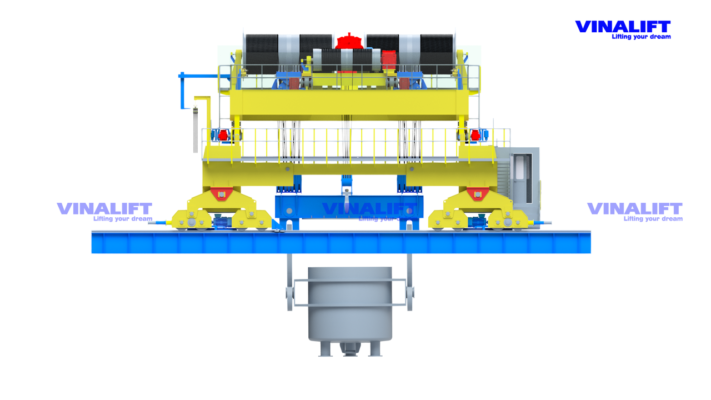
The protection layers usually considered include:
- Redundant hoisting mechanisms to limit the risk of load loss when one load-bearing element fails.
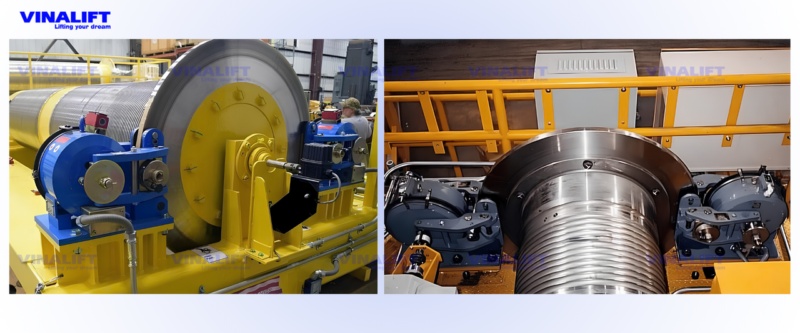
- Multi-layer braking system, in which the service brake and emergency brake perform different roles.
- Hydraulic Emergency Caliper Brake or drum-clamping mechanism acting directly on the rope drum in configurations requiring a high safety level.
- Laminated hook or specialized lifting beam to reduce the risk of single-point destruction in the load-bearing mechanism.
- Overspeed protection mechanism to detect and prevent uncontrolled load drop.
- Real-time monitoring of load, travel, speed, brake status, and operating conditions.
- Safety control architecture that helps the system respond in a controlled manner when power loss, signal fault, or mechanism fault occurs.
When these protection layers operate independently but support one another, the system can significantly reduce the probability of a serious incident and limit the risk of losing load control. This is the foundation of crane safety in metallurgical applications, especially for systems that must transport molten steel above production lines.
Intelligent monitoring technology helps detect risks early
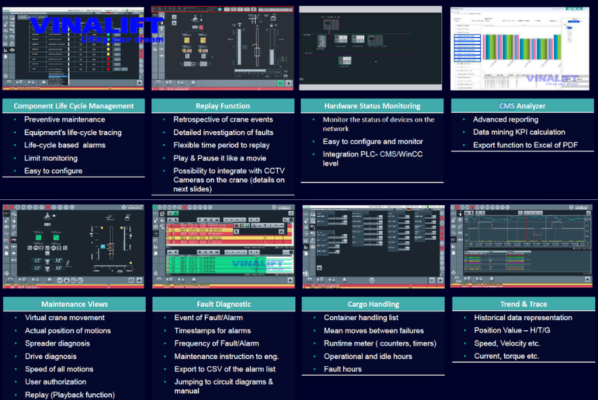
Intelligent monitoring helps the operating team detect early abnormal signs in load, brakes, temperature, vibration, and working cycles before failures develop into serious incidents.
The development of smart factories is helping companies gradually shift from reactive maintenance to data-based maintenance. Instead of inspecting equipment only according to a fixed schedule, modern industrial crane systems can continuously collect data from load cells, encoders, temperature sensors, vibration sensors, brake-status signals, VFDs / frequency inverters, motors, and critical mechanisms.
This data can be transmitted to PLC, SCADA, or MES for operational monitoring, abnormality warnings, and maintenance planning support. For cranes lifting molten steel, the value of data does not only lie in optimizing maintenance cost, but also in early detection of degradation signs before the equipment enters a dangerous state.
Continuous operating data helps detect abnormal signs earlier than reactive maintenance methods, thereby supporting the operating team in planning inspection, maintenance, or controlled equipment shutdown. In high-requirement projects, the monitoring system can also be integrated with predictive maintenance logic, supporting equipment life management according to actual operating cycles.
EPC checklist when evaluating a ladle crane solution
Before selecting a ladle crane supplier, project owners and EPC contractors should clarify the following technical questions:
- What load spectrum, total utilization time, and opferating cycles is the crane classified under?
- Is the double girder, four-girder, or special ladle crane configuration suitable for the plant layout?
- If one rope, one brake, or one drive mechanism fails, can the load still be controlled?
- Does the emergency brake act directly on the drum or a critical load-holding mechanism?
- Are the hook, lifting beam, sheave assembly, and hoisting ropes protected from radiant heat?
- Are the main girder and load-bearing structure calculated according to dynamic loads, load spectrum, and fatigue life?
- Does the system monitor load, temperature, vibration, brake status, and operating cycles?
- Is the design dossier checked against FEM 1.001, EN 13001, EN 13135, TCVN 4244:2005, or equivalent standards according to project requirements?
- Does the manufacturer have a quality management system, inspection procedures, load testing, acceptance process, and clear handover documentation?
- Is there a real case study in a metallurgical plant or similar molten steel lifting application?
These questions help EPC contractors evaluate suppliers not only based on price or nominal lifting capacity, but based on their ability to control risk under real operating conditions.
How VINALIFT approaches risk management in ladle crane projects
VINALIFT approaches ladle crane design by mapping hazard scenarios across the entire molten-steel transport route, rather than sizing the crane only by nominal lifting capacity.
In ladle crane and metallurgical crane projects, VINALIFT does not start with the question “how many tons does the crane need to lift?” The starting point is an analysis of the entire material transport logic in the plant: where the load is lifted, which areas it travels through, how it is affected by temperature and dust, what the operating cycle is, and which risk scenarios are the most serious.
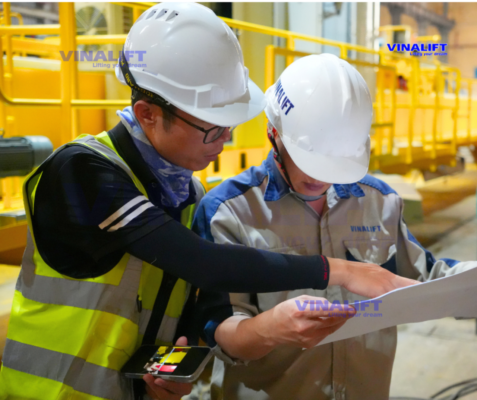
From there, VINALIFT’s engineering team simultaneously considers multiple risk control layers:
- Control from structural design: main girder, lifting beam, load-bearing connections, deflection, dynamic loads, and fatigue life.
- Control from hoisting mechanism: rope, drum, sheave, gearbox, motor, brake, and overspeed protection mechanism.
- Control from load-bearing mechanism: hook, lifting beam, contact points with the molten steel ladle, and resistance to single-point destruction.
- Control from the environment: heat shields, protection of electrical equipment, cabin/electrical room, and components exposed to radiant heat.
- Control from operation: load sensors, brake status monitoring, PLC, SCADA/MES, and data for maintenance.
- Control from quality dossier: design drawings, manufacturing procedures, material inspection, weld inspection, load testing, FAT/SAT, and handover documents according to each project requirement.
This approach reflects VINALIFT’s positioning: not only supplying cranes, but working alongside project owners and EPC contractors in designing a safe lifting solution that fits real operating conditions and can reduce risk throughout the equipment life cycle.
For complex projects, this is the important difference between a conventional equipment supplier and an engineering partner capable of designing non-standard lifting solutions for metallurgical plants.
Capability evidence required in the project dossier
For ladle crane projects, engineering capability should not be demonstrated only through general introductions. Project owners and EPC contractors need to see specific evidence in the technical dossier and manufacturer capability profile.
Important layers of evidence include:
- Design dossier clearly showing load, duty class, load spectrum, speed, operating cycles, and environmental conditions.
- Structural drawings, lifting beam, hook assembly, hoisting mechanism, and safety equipment arrangement.
- Technical explanation for selecting brakes, ropes, drums, sheaves, motors, gearboxes, and electrical equipment.
- Quality control process in production, including material inspection, welding inspection, and assembly inspection.
- Load testing records, factory acceptance records, or site acceptance records depending on project requirements.
- Real case studies in steel plants, metallurgical plants, or similar heavy industrial environments.
- After-sales service capability, maintenance, spare-parts replacement, and technical response when equipment intervention is required.
When this evidence is presented clearly, EPC contractors have a stronger basis for evaluating vendor reliability, instead of only comparing unit prices or lifting parameters in a catalogue.
This is also the dossier that VINALIFT prepares fully for every ladle crane project: from dynamic load calculation explanations according to FEM 1.001, detailed drawings of laminated hook and lifting beam assemblies, ultrasonic weld inspection records, to FAT dossiers witnessed by an independent third party. VINALIFT’s engineering team can provide these documents during the tender stage, without waiting until the contract is signed.
See more:
Steel Industry — HOA PHAT STEEL PLANT 75/20 T LADLE CRANE
Frequently asked questions about risk management in molten steel lifting
1. Why does a ladle crane require a higher safety level than a conventional crane?
A ladle crane transports molten steel ladles at very high temperature. If load control is lost, molten steel may spill onto the floor, cause a steam explosion, destroy equipment, and interrupt the production line. Therefore, a ladle crane must be designed with a heavy-duty class, redundant mechanisms, multi-layer brakes, heat protection, and an operational monitoring system.
2. What is the greatest risk when lifting molten steel?
The greatest risk is load drop or loss of load control. Causes may include brake failure, rope breakage, rope drum overspeed, drive mechanism fault, structural degradation due to material fatigue, or design that is not suitable for the actual load spectrum.
3. Why must risk management begin from the design stage?
Many serious risks cannot be handled only through operating procedures. They must be controlled from the design stage through duty class classification, dynamic load calculation, fatigue life verification, selection of hoisting mechanisms, brakes, hooks, lifting beams, heat protection, and suitable monitoring systems.
4. What protection layers does a ladle crane usually require?
Protection layers usually include redundant hoisting mechanisms, multi-layer brakes, overspeed protection, laminated hooks or specialized lifting beams, heat shields, load monitoring, brake status monitoring, temperature sensors, vibration sensors, and a safety control system.
5. What should EPC contractors ask when selecting a ladle crane supplier?
EPC contractors should ask about duty class, load spectrum, operating cycles, applicable standards, heat protection solution, braking system, redundant mechanisms, CMS, FAT/SAT dossier, material inspection, weld inspection, real case studies, and after-sales service capability.
6. How is VINALIFT’s approach to ladle cranes different from that of conventional equipment suppliers?
VINALIFT approaches the ladle crane as a risk control solution for the entire material transport logic in a metallurgical plant. Instead of designing only by nominal capacity, VINALIFT simultaneously considers the operating environment, load spectrum, duty class, hoisting mechanism, braking system, heat protection, operational monitoring, and quality dossier of each project.
Conclusion
In a metallurgical environment, the greatest risk is not lifting a heavy load, but losing the ability to control the load at the moment when safety is most critical. With a molten steel ladle at extremely high temperature, a single failure can lead to a serious chain of consequences for people, equipment, and the entire production line.
Therefore, risk management in molten steel lifting must begin from design. A safe ladle crane system must be built on multiple control layers: correct duty classification, calculation of dynamic loads and fatigue life, heat protection, redundant mechanisms, multi-layer brakes, overspeed protection, operational monitoring, and clear inspection/acceptance documentation.
For VINALIFT, a ladle crane is not only a lifting device. It is a risk control system for the most hazardous material flow in a metallurgical plant. When designed correctly, controlled correctly, and operated correctly, this system helps project owners and EPC contractors reduce load-loss risk, protect the production line, and improve operating reliability throughout the equipment life cycle.
From metallurgical complexes in Vietnam to steel plants in South America, this is the risk control mindset that VINALIFT consistently applies to every project — regardless of scale or geographic location.
Request a 30-minute design risk assessment session with a VINALIFT engineer
If your project is in the stage of developing the technical dossier or evaluating supplier solutions for a ladle crane, VINALIFT’s engineering team is ready to review the specific risk map for your project operating conditions – benchmark it against the 10-question checklist above – and recommend a suitable equipment configuration before you finalize the tender dossier.
Hotline: (+84) 39 341 6686
Email: contact@vinalift.vn
