


Laminated Hook Engineering in Metallurgical Ladle Cranes
Jul
In the operating history of metallurgical crane systems, most serious hook fracture incidents did not occur because the hook was subjected to loads beyond its design capacity. They occurred because a small fatigue crack — invisible to the naked eye and undetected during periodic inspection — silently propagated through the entire load-bearing section of a solid hook until sudden fracture occurred without any prior warning.
With a ladle crane lifting hundreds of metric tonnes of molten steel at 1,600 °C, there is no second chance after such an incident.
That is why laminated hook engineering was developed — and why the modern metallurgical industry widely specifies laminated hooks for critical ladle crane applications, where resistance to sudden fracture and inspection-based maintenance are essential. This article by VINALIFT analyzes the engineering mechanism of laminated hooks, why they are superior to solid hooks, and how they are applied in real metallurgical crane projects.
The limitations of solid hooks
In the working environment of a metallurgical crane, the hook assembly is continuously subjected to the combined effects of heavy loads, high duty cycles, and radiant heat from the molten steel ladle. When a solid metal structure works under these conditions, micro-cracks may appear in areas of stress concentration.
For solid forged hook or cast hook structures, these cracks tend to propagate continuously from the surface into the material core. Once the crack length exceeds the allowable limit, the load-bearing capacity of the entire hook rapidly decreases and may lead to sudden fracture without any clear deformation warning beforehand. This is an especially serious risk for steel mill crane systems. This is why critical load-bearing mechanisms in metallurgical cranes should be designed and verified under the applicable crane safety framework, including EN 13135 for crane equipment safety requirements, with the objective of limiting the consequences of localized component failure.
Laminated hook engineering
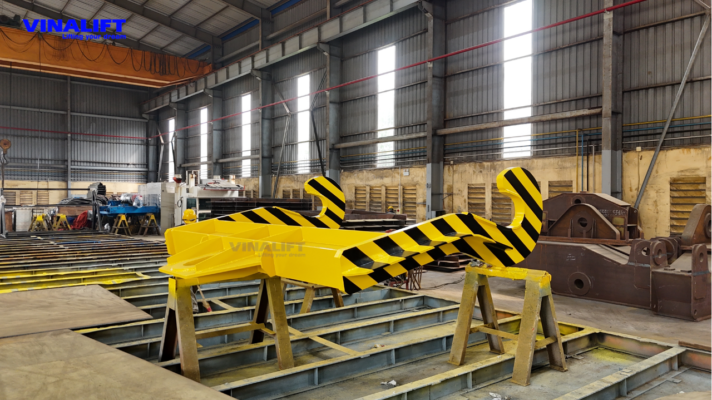
Unlike solid structures, a laminated hook is manufactured by assembling multiple alloy steel plates with thicknesses of approximately 30 mm to 50 mm. These steel plates are machined in synchronization, stacked together, and connected by rivets or high-strength bolts to form a unified load-bearing assembly.
The most important difference in laminated hook engineering lies in its ability to limit crack propagation. When one steel plate develops a fatigue crack, the crack only develops within that specific plate. When it reaches the contact surface between two steel plates, the propagation process is interrupted. This is the crack propagation prevention principle widely applied in lifting equipment serving the metallurgical industry.
Single-failure proof design
Another important advantage of a laminated hook is its ability to retain load-bearing capability under localized plate damage, provided the remaining plates remain within the verified design limits. If one or two outer steel plates develop cracks or fractures, the remaining plates continue to participate in load bearing. This creates a natural mechanical redundancy mechanism that a solid structure cannot provide.
This design philosophy is aligned with the single-failure proof design objective commonly applied to metallurgical ladle crane systems transporting molten metal. Instead of depending entirely on one single component, the load is distributed across multiple independent load-bearing layers. As a result, the maintenance team can detect damage through periodic inspection and proactively plan replacement before a serious incident occurs.
See more: [Single-Failure Proof Design Philosophy in Ladle Cranes] — the six-layer Single-Failure Proof architecture, in which the laminated hook is one of the foundational mechanical redundancy layers.
The role of the lifting beam assembly
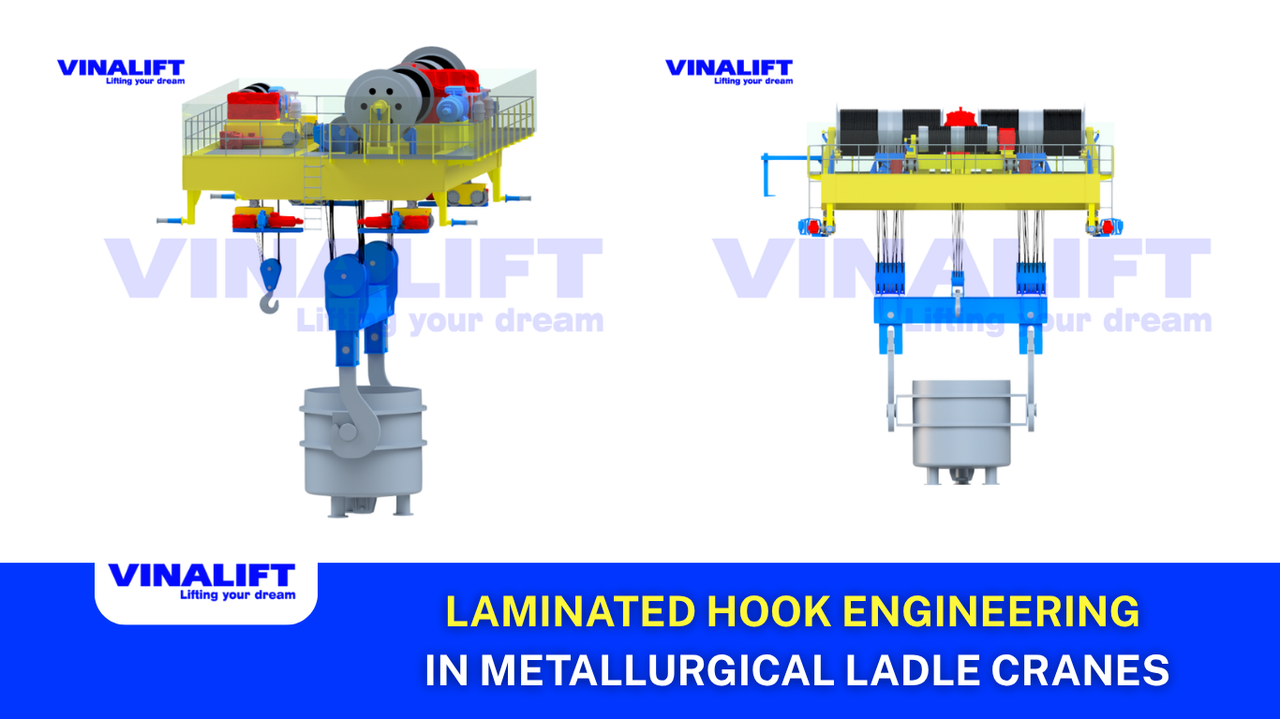
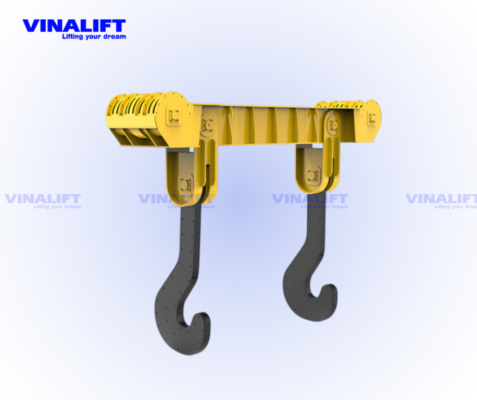
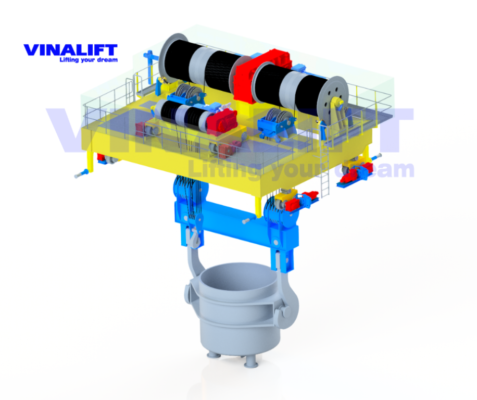
In practice, molten steel ladles are very large, so a single suspension point cannot be used. Ladle crane systems often use a lifting beam or spreader beam assembly in the form of a high-strength box beam or H-beam. Two laminated hook assemblies are arranged at both ends of the beam to connect with the two trunnions of the molten steel ladle.
This solution helps distribute the load evenly across two suspension points, while creating sufficient distance for the sheave system and hoisting ropes to be offset from the heat column rising from the mouth of the ladle.
This is an important design requirement for metallurgical ladle cranes using double-girder overhead crane configurations.
Heat shield and rope system
Radiant heat from molten steel can directly affect the service life of hoisting ropes, sheave bearings, and mechanical components located above the ladle. To reduce this impact, engineers often arrange a heat shield system on the underside of the lifting beam. The heat shield structure usually includes a heat-resistant steel layer combined with insulating materials such as ceramic fiber or mineral wool. This protection layer helps limit heat transfer to the sheave assembly and steel ropes while maintaining stable working conditions for the entire hoisting mechanism. At the hook neck position closest to the heat source, wear-resistant plates may be additionally installed to reduce mechanical wear and improve protection for the main load-bearing structure.
Auxiliary hoist and hook mechanism
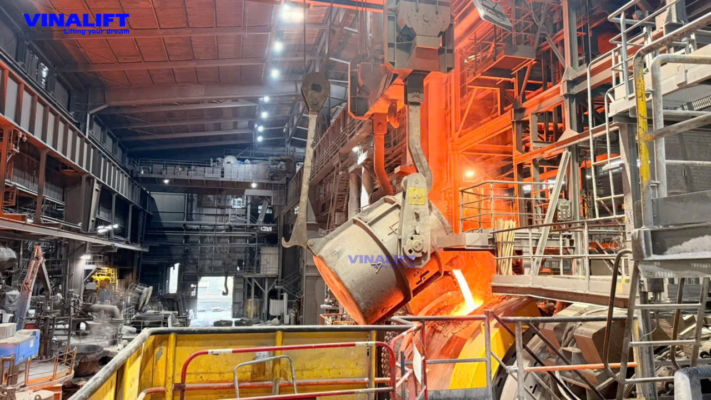
In addition to the main hook assembly used to lift and transport the molten steel ladle, molten steel lifting crane systems are also equipped with an auxiliary hook mechanism. The auxiliary hook usually has a smaller capacity and is used to control the ladle tilting process. When the auxiliary hook lifts the connection point at the bottom of the ladle, the ladle rotates around the trunnion axis held by the main hook assembly. This solution allows control of the molten steel flow during pouring and is one of the important technical characteristics of specialized metallurgical crane systems.
Laminated hook design standards
The important point in EN 13001 requirements is a change in evaluation mindset: instead of only checking the maximum static load, this standard requires evaluation of the entire load spectrum — what percentage of operating cycles occur at high load, medium load, and low load — to calculate total accumulated fatigue damage over time.
With a solid hook, when a fatigue crack appears, the entire load-bearing section of the hook is affected. This is why modern design standards such as EN 13001 require very high fatigue safety factors for critical load-bearing components — a requirement that often pushes the size and weight of solid hooks to very large levels compared with the actual load to be lifted.
By contrast, the laminated structure disperses fatigue cracks by individual plates. This does not eliminate fatigue — it restructures the way damage progresses, from sudden fracture into step-by-step degradation that can be detected through periodic inspection. This is the foundation that allows metallurgical crane systems specified under FEM A8 duty classification to maintain continuous operation while controlling long-term structural risk.
See more: [European-standard ladle crane acceptance testing procedure for EPC] — Step 1 describes the procedure for inspecting the steel structure and crane girder quality dossier before delivery, including 100% UT ultrasonic inspection of the hook assembly.
VINALIFT design and manufacturing capability
VINALIFT performs the full chain in-house — from structural calculation, selection of laminated plate parameters, factory manufacturing, to installation and commissioning at site. This closed-loop capability allows control down to each steel plate in the hook assembly and the entire lifting beam system, instead of depending on foreign sub-vendors for the most critical safety components of a *metallurgical crane*.
Typical project
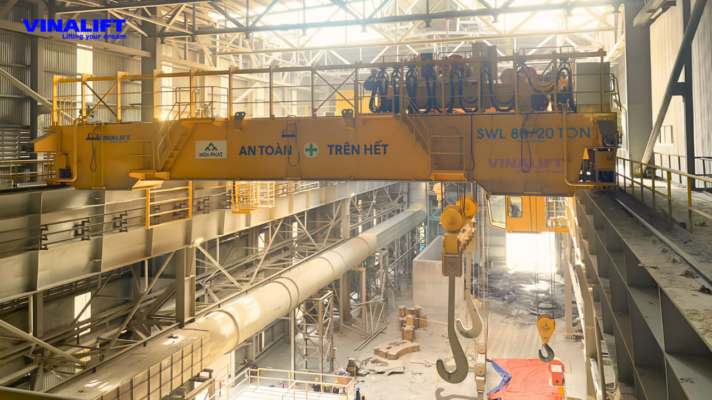
Steel industry — 75/20 t ladle crane — Hoa Phat Steel Plant
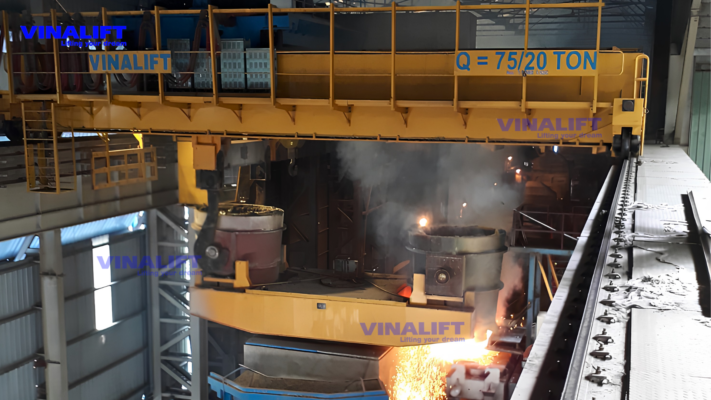
02 units | Span 19.5 m | Lifting height 19 m | Duty class A8 according to FEM 1.001
Context: FEM A8 is one of the highest duty classifications under FEM 1.001 for crane working groups, corresponding to very intensive service over the equipment life cycle, continuous 24/7 operation in the furnace area with direct radiant heat from the 1,600°C molten steel ladle below the hook assembly.
Challenge: The 75-ton load combined with extremely high cycle frequency creates greater accumulated fatigue damage than any other application in the industry. A solid hook under this duty class would be required to have a very high fatigue safety factor according to EN 13001 — pushing its size and weight to an impractical level, while still providing less inherent crack-arrest capability than a laminated hook if a fatigue crack begins to propagate.
Implemented solution: VINALIFT designed the laminated hook assembly with alloy steel plates machined in synchronization, connected by rivets, and calculated according to the actual Q4 load spectrum of A8 duty. The crack propagation prevention principle ensures that localized damage does not propagate across the entire section. The equipment has operated stably since delivery, with structural integrity verified through periodic inspection during continuous service.
Technical support and after-sales service
When an incident occurs with the laminated hook assembly or lifting beam — whether it is a cracked steel plate or hook neck wear — VINALIFT’s engineering team is present at site within 24 hours with a permanent spare-parts inventory maintained in Vietnam. Recovery time does not depend on lead time for orders from Europe or Korea. For a metallurgical line operating 24/7, that is the difference between stopping the furnace for a few hours and stopping it for several weeks.
From load spectrum calculation to inspection of each steel plate before delivery — VINALIFT controls that entire chain at its Hai Phong factory, without depending on foreign sub-vendors for the most critical safety components of a *metallurgical crane*. This is how VINALIFT builds each brick for Vietnam’s industrial legacy on the global EPC map.
Conclusion
For ladle crane systems, selecting Laminated Hook Engineering is not simply choosing a hook type with higher load-bearing capacity. It is an engineering solution designed to improve *fatigue resistance*, increase fracture resistance, and build a mechanical redundancy mechanism suitable for the operating requirements of the metallurgical industry.
Thanks to the principle of preventing crack propagation and the ability to maintain the load when localized damage occurs, the laminated hook has become the standard choice in crane safety systems, especially in applications transporting molten steel and large-capacity molten metals.
Request a sample laminated hook calculation sheet and a 30-minute technical consultation with a VINALIFT engineer
If you are preparing a technical specification for a ladle crane or evaluating the hook solution of your current supplier, VINALIFT’s engineering team is ready to provide an actual laminated hook assembly calculation sheet — including load spectrum, fatigue safety factor according to EN 13001, and periodic inspection plan — and work directly with you to assess the long-term structural risk for your specific project.
- Hotline: (+84) 39 341 6686
-
Email: contact@vinalift.vn
