


Heavy-Duty Crane Manufacturer Capability Checklist for EPC Projects
Jul
EPC Project Directors rarely face a shortage of crane suppliers. The greater challenge is distinguishing manufacturers with proven engineering and execution capability from those whose qualifications exist primarily on paper.
The consequence of that mistake is not simply equipment failure—it. It is the complete shutdown of a steel production line. A 150T molten steel ladle at 1,600°C is drifting under load because the braking system has no redundancy. A main girder develops fatigue cracks after only 18 months of operation because the manufacturer failed to classify the crane and its mechanisms against the specified operating cycles, load spectrum, and required design life.
This article from VINALIFT provides a Heavy-duty crane manufacturer audit checklist for Project Director—seven technical evaluation criteria that can be immediately incorporated as a mandatory screening tool in tender documents before any proposal is considered.
Equipment Risks and EPC Schedule Challenges in Steel Plants
In heavy industrial EPC projects, specialized lifting equipment is a critical part of the production and material-flow system. Its availability can directly affect commissioning activities, production continuity and plant output. Unlike conventional workshop applications, steel plant crane systems must operate under extreme thermal radiation, highly abrasive metallic slag dust, and severely corrosive atmospheres.
If an EPC contractor selects a crane manufacturer without sufficient engineering, manufacturing and project-execution experience with heavy-duty overhead crane structures, the consequences emerge quickly in the form of metal fatigue, cracked main girder welds, or electrical faults or short circuits caused by conductive graphite dust entering inadequately protected control cabinets. For Project Directors, these failures translate into substantial operating expenditure (OPEX), extended plant downtime, and delays to the overall project handover schedule. Therefore, implementing a rigorous pre-tender qualification process for lifting equipment manufacturers is essential.
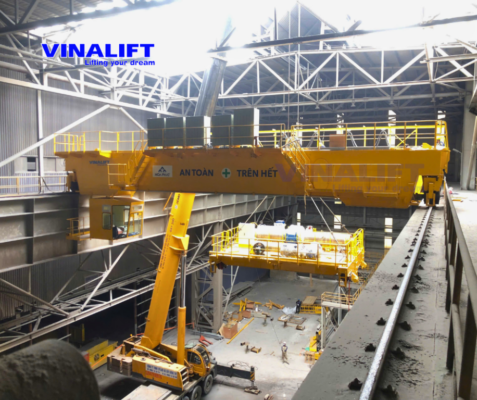
Heavy-duty crane manufacturer audit checklist for Project Director
The following checklist combines design and safety considerations from recognized crane standards with manufacturing quality, documentation, and EPC execution requirements. The applicable standards must be confirmed against the contractual design basis and destination market.
It enables EPC Project Directors to rapidly classify and evaluate the actual capabilities of crane manufacturers.
| No. | Audit criterion | Minimum technical requirement | Manufacturer verification method | Project risk if not compliant |
| 1 | Design Standard & Duty Classification | Class A6/M6 to A8/M8 compliant with FEM 1.001 | Fatigue calculation report, box girder anti-torsion design drawings, dynamic load calculation documents | Main girder deflection, cracked girder welds, gearbox and hoisting motor overheating due to overload |
| 2 | Quality Management Certification | ISO 9001:2015 crane manufacturing plant certification | Valid ISO certification | Girder fabrication tolerance deviations and mechanical assembly defects |
| 3 | Redundant Hoisting System | Single-Failure Proof philosophy, dual-wire-rope system, synchronized dual-hoist motors | Main hoisting kinematic diagram and verification of Half-speed Mode functionality | Single wire rope failure or primary hoisting motor failure |
| 4 | Two-Tier Safety Braking System | Minimum of two service brakes on the high-speed shaft plus one emergency brake acting directly on the rope drum flange | Hydraulic emergency brake schematic and Fail-Safe certification (spring-applied, hydraulically/electrically released) | Gearbox shaft fracture or transmission gear failure causing uncontrolled free-fall of the suspended load |
| 5 | Specialized Load-Carrying Device | Hook beam assembly equipped with a Laminated Hook fabricated from multiple riveted or bolted steel plates | Plate cutting process, 100% UT inspection procedure, material certificates | Conventional forged hook develops thermal fatigue cracks and fails unexpectedly |
| 6 | Smart Safety & Monitoring Technology | Integrated Sensorless Anti-Sway, Absolute Positioning System, and ISO 12482 fatigue life monitoring | PLC/VFD control algorithm demonstration and verification of live CMS operating data displayed on the HMI | Excessive oscillation of the molten steel ladle |
| 7 | Origin of Core Components | All major components (motors, gearboxes, VFDs, PLCs, brakes, wire ropes) supplied by G7 or European manufacturers such as Siemens, Flender, SEW, and ABB | Detailed CO/CQ documentation and original manufacturer quality certificates | Repeated equipment failures resulting in prolonged production interruptions |
Explanation of the audit criteria
An ISO 9001-certified quality management system is an important qualification criterion, provided that its scope covers the activities relevant to the contract. It should be evaluated together with the manufacturer’s engineering capability, welding controls, inspection resources and project references. Project Directors should require bidders to clearly present their structural fatigue calculations for the crane steelwork.
The main girder configuration should be selected and verified against the required span, wheel loads, stiffness, fatigue performance, torsional effects, and fabrication constraints. The bidder should provide structural calculations demonstrating the suitability of the proposed girder system. Instead, it shall utilize a welded box girder specifically engineered for heavy-duty applications, incorporating internal diaphragms spaced at intervals of 1.0 m to 1.5 m to prevent local buckling and structural deformation.
In addition, The EPC contractor should review the supplier’s WPS and supporting procedure-qualification records, welder qualifications, weld map, acceptance criteria and NDT plan. Weld type, examination method, and inspection extent should be defined according to the joint category, applicable standard and approved Inspection and Test Plan. If the bidder cannot provide adequate welding and inspection records, the EPC contractor will have limited evidence that critical fabrication requirements have been consistently controlled and verified.
Beyond these seven criteria, one critical requirement is frequently overlooked during tender preparation — the protection of the electrical control system against conductive graphite dust. This dust, which is characteristic of steelmaking workshops, can cause VFD cabinet short circuits after only a few months of operation if the electrical room is not designed with positive air pressure. A qualified manufacturer shall therefore provide electrical room design drawings together with cooling and air filtration specifications, rather than relying solely on ISO certification documents.
Read More: [Single-Failure Proof Philosophy: Why a Minor Failure Must Never Result in Load Drop]
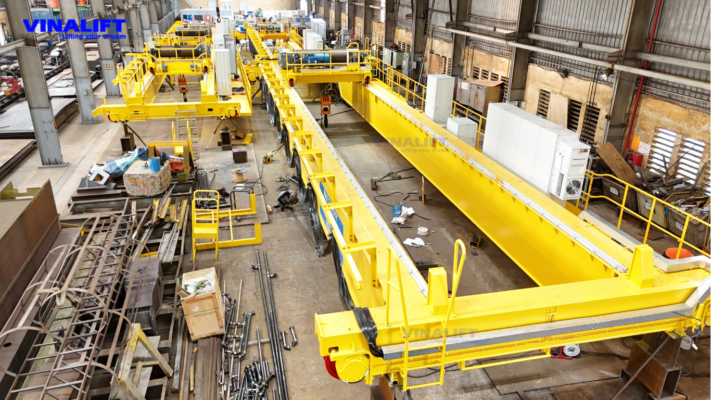
Technical overview of steel plant cranes
To assist EPC Project Directors during the review of Technical Specification Sheets, the following section summarizes the key technical requirements for each category of lifting equipment used throughout a metallurgical production process.
Charging crane and ladle crane
These are the two heaviest lifting systems installed at the center of the steelmaking workshop.
- Charging crane: Charging crane systems generally utilize a main hook together with an auxiliary hook to lift scrap buckets weighing hundreds of tonnes for charging Electric Arc Furnaces (EAF). Charging cranes are used to transport scrap charging baskets or other furnace-charging equipment within the meltshop. Their design should account for the specified operating cycle, dynamic effects, load-handling arrangement, furnace interface and environmental conditions.
- Double girder ladle crane or four-girder ladle crane: Depending on the required capacity, span, plant layout and safety architecture, a ladle crane may use a double-girder, four-girder or another purpose-engineered configuration. For higher-capacity or safety-critical applications, multi-girder configurations may be adopted to satisfy the required load paths, trolley arrangement, stiffness and redundancy concept.
Ladle cranes are primarily used to transport molten-metal ladles between furnaces, secondary refining areas, and continuous-casting operations. Billets, slabs and coils are generally handled by separate purpose-designed cranes and lifting attachments. Within secondary refining shops and continuous casting facilities. Based on the thermal and contamination assessment, the design may require heat shields, heat-resistant wire-rope arrangements, protected cable routing, enhanced enclosure protection and filtered or pressurized cooling for electrical equipment.
Billet, Slab and Coil Handling Cranes
- Billet/Slab Handling Crane: This type of billet and coil handling crane handles red-hot billets at temperatures ranging from 800°C to 1,000°C. The load-handling device typically consists of heat-resistant electromagnets equipped with an automatic emergency battery backup capable of maintaining a magnetic holding force for 15–20 minutes following an unexpected power failure.
- Coil Handling Crane: Finished coil handling cranes generally utilize C-hooks or dedicated electro-mechanical coil grabs. The system shall integrate VFD closed-loop vector control with speed feedback encoders to achieve accurate positioning during steel coil stacking while preventing scratches on cold-rolled coils and coated steel products.
-
Auxiliary Suspension Crane: In smaller maintenance workshops, suspension cranes or low-capacity custom overhead cranes are installed to support equipment disassembly and maintenance during scheduled furnace shutdowns.
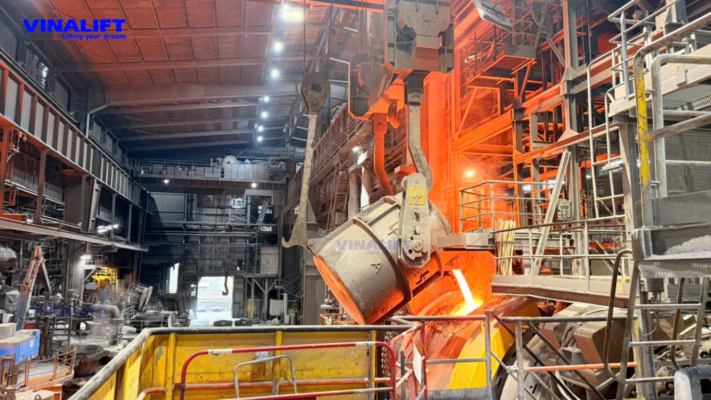
VINALIFT project references
- Background: The slag handling workshop and HRC1 hot rolling line at Hoa Phat Dung Quat operate continuously 24/7. Ambient temperatures frequently exceed 60°C, while the concentration of abrasive metallic slag dust remains extremely high. This represents one of the harshest operating environments within Vietnam’s steel industry.
- Challenge: The equipment was required to meet FEM A6 duty classification, withstand continuous impact and vibration, and ensure complete protection of the electrical control system against conductive dust — a requirement that most conventional suppliers could not satisfy without a customized engineering solution.
- Implementation Solution: VINALIFT designed a dedicated thermally insulated operator cabin together with a positive-pressure electrical room to prevent graphite dust intrusion. The crane integrates ABB/Siemens variable frequency drives, operates on QU80 crane rails, provides a 20 m main hook lifting height and a 24 m auxiliary hook lifting height with a 19 m span. All main girder welds underwent 100% Ultrasonic Testing (UT) before shipment under VINALIFT’s ISO 9001:2015-certified quality management system.
Steel Industry – 10T Gantry Crane – Thai Nguyen Iron and Steel Plant
- Span: (6+30+6) m | Lifting Height: 15 m | Duty Class: A6
- Application: Billet handling within the steelmaking workshop
All equipment was manufactured under an ISO 9001:2015 crane manufacturing plant quality management system, with 100% Ultrasonic Testing (UT) performed on all main girder welds before delivery.
VINALIFT’s execution capability is supported by its ISO 9001:2015-certified quality management system together with integrated engineering, manufacturing, and quality control processes that satisfy the specialized technical requirements of industrial crane projects in general and steel and metallurgical plants in particular.
Conclusion
EPC contractors do not select the wrong crane manufacturer because they lack information — they make the wrong choice because they lack the right screening tool. Every item in the checklist above represents a potential project failure: fatigue cracking of the main girder during operation, uncontrolled load drop during a power failure, or the collapse of the overall EPC schedule because a single wire rope lacked redundancy.
Integrate this checklist into your tender documentation as a mandatory technical screening tool before evaluating any supplier proposal.
VINALIFT has been working alongside leading EPC contractors to deliver internationally compliant heavy industrial projects in Vietnam. Every crane leaving our manufacturing facility is more than a piece of equipment — it is an engineering commitment to minimizing lifting-equipment-related downtime and protecting production continuity.
Request a 30-minute technical consultation with a VINALIFT design engineer
If you are preparing tender documents or evaluating vendors for a steel plant project, the VINALIFT engineering team is ready to work directly with you to identify the project’s specific technical requirements and potential risks—not to provide generic recommendations.
Hotline: (+84) 39 341 6686
Email: contact@vinalift.vn
